Leucine Benefits and Uses: A Simple Guide to This Powerful Amino Acid
Leucine is a small nutrient with a big role in your body. Many people hear its name in fitness talks or protein discussions, but very few truly understand what it does and why it matters. This article explains leucine in very simple English, with real-life examples, clear points, tables, and a natural human tone. No heavy science, no confusing words—just useful information you can actually understand and use 😊
What is leucine and why people talk about it so much
Leucine is an essential amino acid. “Essential” means your body cannot make it on its own. You must get it from food. It is one of the three BCAAs (Branched-Chain Amino Acids), along with isoleucine and valine.
But leucine is special. Out of all amino acids, leucine plays the strongest role in muscle building and repair. That’s why athletes, gym-goers, and even doctors talk about it often.
In simple words, leucine tells your body:
“Hey, we have enough protein. Let’s build and repair muscles now.”
Without leucine, protein inside your body does not work properly.
How leucine works inside the body (explained simply)
When you eat food that contains protein, your body breaks it down into amino acids. Leucine then activates a process called muscle protein synthesis.
You don’t need to remember the technical name. Just remember this:
Leucine acts like a switch that turns muscle building ON 🔛
It also helps:
- Reduce muscle breakdown
- Support energy during exercise
- Help cells grow and repair
Even if you eat a lot of protein, low leucine means weak results.
Leucine and muscle growth (main reason people use it)
This is where leucine really shines 💪
Leucine:
- Helps muscles grow faster
- Reduces muscle loss during dieting
- Speeds up recovery after workouts
- Improves strength over time
This is why many protein powders highlight “high in leucine” on their labels.
Simple example:
Two people eat the same amount of protein.
The one with higher leucine intake builds muscle faster.
That’s how powerful it is.
Leucine for people who don’t go to the gym
Leucine is not only for bodybuilders. Regular people also benefit from it.
It helps:
- Older adults prevent muscle loss (very important with age)
- People recovering from illness or surgery
- Office workers with weak muscles
- People with low appetite or poor diet
Muscle loss can start as early as age 30. Leucine helps slow that down.
Leucine and fat loss (yes, it helps here too)
Leucine does not directly burn fat like caffeine. But it helps in a smarter way.
It:
- Preserves muscle while dieting
- Improves metabolism
- Helps control blood sugar
- Reduces cravings by improving protein satisfaction
When muscles are strong, your body burns more calories—even at rest.
So leucine supports fat loss indirectly, but effectively 👍
Leucine and blood sugar control
Leucine helps improve insulin sensitivity. That means your body uses sugar from blood more efficiently.
This is helpful for:
- People with insulin resistance
- People trying to avoid blood sugar spikes
- Those following high-protein diets
Balanced blood sugar = stable energy = fewer cravings.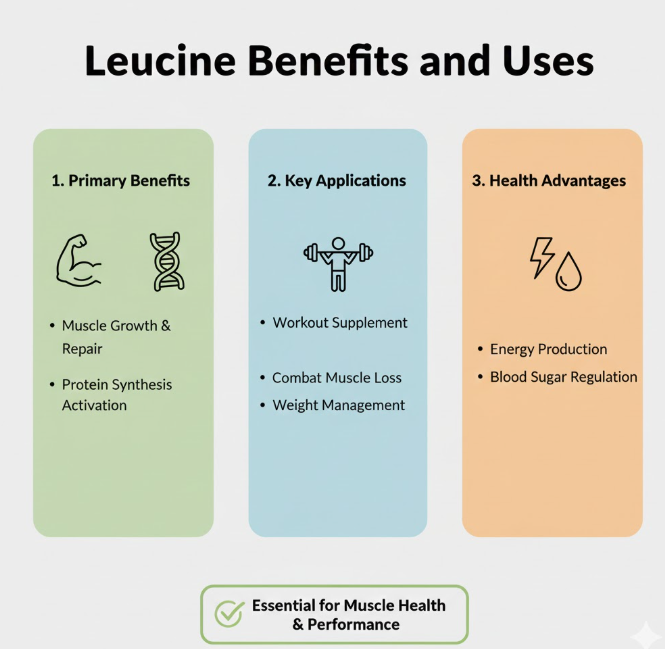
Leucine and brain health
This part is often ignored, but it matters.
Leucine helps:
- Support brain signaling
- Improve focus indirectly
- Reduce mental fatigue when combined with proper nutrition
It does not work like caffeine, but it supports overall brain function quietly.
Natural food sources of leucine
You don’t always need supplements. Many everyday foods contain leucine.
Here is a simple table 👇
| Food Item | Leucine per 100g (approx.) |
|---|---|
| Chicken breast | 1.7 g |
| Beef | 1.6 g |
| Eggs | 1.1 g |
| Milk | 0.9 g |
| Cheese | 2.8 g |
| Fish | 1.5 g |
| Soybeans | 2.7 g |
| Lentils | 1.3 g |
| Peanuts | 1.5 g |
Animal foods generally contain more leucine than plant foods. That’s why vegetarians need to plan carefully.
Leucine for vegetarians and vegans
Yes, vegetarians can get leucine too 🌱
Good plant sources include:
- Soy and tofu
- Lentils and beans
- Chickpeas
- Nuts and seeds
- Quinoa
However, plant protein usually has less leucine. Mixing different plant foods helps cover the gap.
Some vegans use leucine or BCAA supplements for this reason.
Leucine supplements: do you really need them
Supplements are not magic. They are only helpful when food is not enough.
You may consider leucine supplements if:
- You train hard and often
- You are older than 40
- You eat very little protein
- You are on a calorie-restricted diet
- You are vegetarian with low protein intake
For normal people eating balanced meals, food is usually enough.
Best time to take leucine (food or supplement)
Timing matters a little ⏰
Best times:
- After workout (most popular)
- With meals that are low in protein
- Before sleep (for muscle recovery)
Leucine works best when taken with other amino acids or protein.
How much leucine does the body need
There is no single number for everyone, but here is a simple idea:
- Average adult: 2–3 grams per day
- Active people: 3–5 grams per day
- Older adults: slightly higher intake helps
Most people get enough leucine if they eat enough protein.
Too much leucine: is it dangerous
Leucine is generally safe when taken in normal amounts.
But very high doses for long periods may:
- Upset digestion
- Cause imbalance with other amino acids
- Stress the kidneys in people with kidney issues
Balance is the key. More is not always better.
Leucine vs other BCAAs (simple comparison)
| Amino Acid | Main Role |
|---|---|
| Leucine | Muscle growth trigger |
| Isoleucine | Energy and endurance |
| Valine | Muscle repair and balance |
Leucine is the leader, but the others support it.
Common myths about leucine
❌ Myth: Leucine alone builds muscle
✅ Truth: It works best with full protein and training
❌ Myth: Only athletes need leucine
✅ Truth: Everyone needs it for muscle health
❌ Myth: Supplements are better than food
✅ Truth: Real food always comes first
Who should pay extra attention to leucine intake
- Older adults 👴
- People recovering from injury
- Athletes and gym users
- Vegetarians and vegans
- People on weight-loss diets
For these groups, leucine can make a noticeable difference.
Simple daily diet example with leucine
Breakfast:
- Eggs and milk 🥚🥛
Lunch:
- Chicken or lentils with rice 🍛
Snack:
- Yogurt or nuts 🥜
Dinner:
- Fish or tofu with vegetables 🥦
This kind of diet naturally provides enough leucine.
Frequently Asked Questions (FAQs)
Is leucine safe to take daily?
Yes, when taken in normal amounts from food or supplements, leucine is safe for daily use.
Can leucine help with muscle loss in old age?
Yes. Studies show leucine helps slow down age-related muscle loss.
Is leucine good for weight loss?
Indirectly, yes. It helps preserve muscle and improves metabolism.
Can I take leucine without exercise?
Yes, but benefits are stronger when combined with physical activity.
Is leucine better than whey protein?
Leucine is part of whey protein. Whey gives leucine plus other amino acids, so whey is more complete.
Final thoughts on leucine
Leucine is not a trend. It is a basic building block your body truly needs. From muscle strength to recovery, from aging support to better metabolism, leucine plays a quiet but powerful role.
You don’t need to overthink it. Eat enough protein, choose good food, stay active, and leucine will do its job in the background—just like a good helper should 😊
If used wisely, leucine can support a stronger, healthier, and more energetic life without any complicated rules.