Amino acids are often called the building blocks of life, and for a good reason. Every cell in your body relies on them. They help form proteins, repair tissues, support the immune system, and even influence your mood and brain function.
Without amino acids, your body simply wouldn’t function the way it does today. Muscles wouldn’t grow, enzymes wouldn’t work, and many vital processes would stop. That’s why scientists consider amino acids one of the most essential components of human biology.
This guide will walk you through everything you need to know about amino acids — from their chemical structure to their role in metabolism, health, and nutrition. Whether you’re a student, a fitness enthusiast, or simply curious about biology, this article will give you a clear and complete understanding of amino acids and their functions.
Why Amino Acids Matter in the Human Body
Proteins are everywhere in your body. They build muscles, skin, hair, enzymes, hormones, and even parts of your immune system. But proteins themselves are made from smaller units called amino acids.
Think of amino acids like letters in the alphabet. Individually, each letter has meaning, but when combined, they create words and sentences. In the same way, amino acids combine to form proteins that perform countless biological tasks.
Key Roles of Amino Acids
Amino acids perform several important functions:
-
Build and repair tissues
-
Create enzymes and hormones
-
Support immune function
-
Transport nutrients
-
Help produce energy
-
Regulate metabolism
-
Maintain healthy skin, hair, and nails
Without enough amino acids, the body may experience muscle loss, fatigue, slow healing, and weakened immunity.
The Basic Structure of Amino Acids
Every amino acid has a similar chemical structure. Scientists describe it as a central carbon atom connected to four groups.
Core Components of an Amino Acid
| Component | Description |
|---|---|
| Amino Group (NH₂) | Contains nitrogen and acts as a base |
| Carboxyl Group (COOH) | Acts as an acid |
| Hydrogen Atom | Attached to the central carbon |
| Side Chain (R group) | Unique part that makes each amino acid different |
Simple Structure Diagram
|
H2N — C — COOH
|
R
The R group determines the type of amino acid and its properties.
For example:
-
Some amino acids are hydrophilic (water-loving)
-
Some are hydrophobic (water-repelling)
-
Others carry positive or negative charges
These differences allow proteins to fold into complex shapes and perform specialized functions.
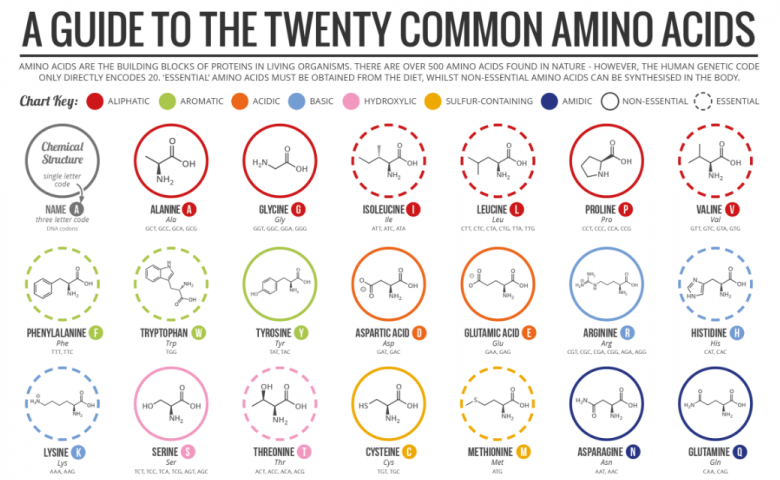
The 20 Standard Amino Acids
Scientists have identified 20 standard amino acids that build most proteins in the human body.
These amino acids are grouped into three main categories:
-
Essential amino acids
-
Nonessential amino acids
-
Conditional amino acids
Essential Amino Acids Your Body Cannot Produce
Essential amino acids must come from food because the body cannot synthesize them on its own.
List of Essential Amino Acids
| Essential Amino Acid | Primary Function |
|---|---|
| Histidine | Growth and tissue repair |
| Isoleucine | Muscle metabolism |
| Leucine | Muscle protein synthesis |
| Lysine | Calcium absorption |
| Methionine | Detoxification and metabolism |
| Phenylalanine | Neurotransmitter production |
| Threonine | Skin and collagen production |
| Tryptophan | Serotonin production |
| Valine | Muscle repair and energy |
Foods Rich in Essential Amino Acids
-
Eggs
-
Meat
-
Fish
-
Dairy
-
Quinoa
-
Soy
-
Beans and lentils
These foods are often called complete proteins because they contain all essential amino acids.
Nonessential Amino Acids Your Body Can Make
Unlike essential amino acids, the body can produce nonessential amino acids from other compounds.
Common Nonessential Amino Acids
| Amino Acid | Key Role |
|---|---|
| Alanine | Energy production |
| Asparagine | Nervous system support |
| Aspartic acid | Hormone production |
| Glutamic acid | Brain function |
| Serine | Fat metabolism |
Even though the body produces them, they remain crucial for metabolic processes.
Conditional Amino Acids in Special Situations
Some amino acids become essential during stress, illness, or intense exercise. These are called conditional amino acids.
Examples Include
-
Arginine
-
Cysteine
-
Glutamine
-
Glycine
-
Proline
-
Tyrosine
For example:
-
Glutamine supports immune health
-
Arginine helps with wound healing
-
Tyrosine contributes to neurotransmitter production
Athletes and patients recovering from illness may need higher amounts of these amino acids.
Amino Acids and Protein Formation
Proteins are formed through a process called peptide bonding.
How It Works
-
Two amino acids join together
-
A water molecule is removed
-
A peptide bond forms between them
-
Chains of amino acids create polypeptides
-
Polypeptides fold into proteins
Protein Formation Flow
The sequence of amino acids determines the protein’s shape and function.
Even a small change in sequence can affect how a protein works.
The Four Structural Levels of Proteins
Proteins fold into complex shapes that determine their biological role.
1. Primary Structure
The linear sequence of amino acids.
2. Secondary Structure
Local folding patterns such as:
-
Alpha helices
-
Beta sheets
3. Tertiary Structure
The overall 3D shape of the protein.
4. Quaternary Structure
Multiple protein chains working together.
Examples include:
-
Hemoglobin (oxygen transport)
-
Antibodies (immune defense)
Amino Acids and Metabolism
Amino acids play a huge role in metabolic processes.
They help convert nutrients into energy and regulate many chemical reactions.
Major Metabolic Roles
-
Producing glucose when carbohydrates are low
-
Supporting fat metabolism
-
Synthesizing neurotransmitters
-
Creating enzymes
Energy Production
When needed, amino acids can enter energy pathways such as:
| Pathway | Purpose |
|---|---|
| Glycolysis | Energy production |
| Krebs Cycle | Cellular respiration |
| Gluconeogenesis | Glucose formation |
Although carbohydrates and fats are the main fuel sources, amino acids provide backup energy during fasting or intense exercise.
Amino Acids and Brain Function
Your brain relies heavily on certain amino acids to produce neurotransmitters.
Important Brain-Related Amino Acids
| Amino Acid | Neurotransmitter Produced |
|---|---|
| Tryptophan | Serotonin |
| Tyrosine | Dopamine |
| Glutamate | Excitatory signals |
| Glycine | Inhibitory signals |
These chemicals influence:
-
Mood
-
Sleep
-
Focus
-
Motivation
-
Memory
For example:
Low tryptophan levels may lead to reduced serotonin, which is associated with mood disorders.
Amino Acids and Muscle Growth
One of the most well-known roles of amino acids is muscle development and repair.
Branched-Chain Amino Acids (BCAAs)
Three amino acids are particularly important for muscles:
| BCAA | Function |
|---|---|
| Leucine | Stimulates muscle protein synthesis |
| Isoleucine | Improves energy metabolism |
| Valine | Reduces muscle fatigue |
Athletes often consume BCAA supplements to enhance recovery and performance.
Muscle Recovery Benefits
-
Reduce muscle soreness
-
Improve endurance
-
Support tissue repair
-
Prevent muscle breakdown
Amino Acids and the Immune System
Your immune system depends on amino acids to produce antibodies and immune cells.
Immune-Supporting Amino Acids
| Amino Acid | Role |
|---|---|
| Glutamine | Fuels immune cells |
| Arginine | Supports wound healing |
| Cysteine | Antioxidant production |
Without enough amino acids, immune responses become weaker and infections may occur more easily.
Food Sources of Amino Acids
A balanced diet usually provides sufficient amino acids.
Complete Protein Sources
These foods contain all essential amino acids:
-
Eggs
-
Chicken
-
Fish
-
Milk
-
Yogurt
-
Quinoa
-
Soy products
Plant-Based Protein Sources
Many plant foods contain amino acids but may lack one or more essential types.
Examples include:
-
Beans
-
Lentils
-
Chickpeas
-
Nuts
-
Seeds
-
Whole grains
Combining foods like rice and beans creates a complete amino acid profile.
Amino Acid Chart: Common Food Sources
| Food | Amino Acid Content |
|---|---|
| Eggs | All essential amino acids |
| Chicken | High in leucine and lysine |
| Fish | Rich in methionine |
| Soybeans | Complete plant protein |
| Lentils | High in lysine |
| Almonds | Arginine and glutamate |
Amino Acid Supplements: Do You Need Them?
Amino acid supplements are popular among athletes and bodybuilders.
Common supplements include:
-
BCAA powders
-
Essential amino acid blends
-
Glutamine capsules
-
Arginine supplements
Potential Benefits
-
Faster muscle recovery
-
Improved endurance
-
Enhanced protein synthesis
-
Reduced fatigue
However, most people can obtain enough amino acids through balanced nutrition.
Supplements should be used carefully and preferably under professional guidance.
What Happens When Amino Acids Are Deficient?
Amino acid deficiency can lead to several health problems.
Possible Symptoms
-
Muscle weakness
-
Fatigue
-
Hair loss
-
Poor wound healing
-
Weak immune system
-
Mood changes
Severe protein deficiency may lead to conditions such as:
-
Kwashiorkor
-
Marasmus
These are more common in regions with limited food access.
Fascinating Facts About Amino Acids
Here are some interesting facts that many people don’t know:
-
The human body contains over 100,000 different proteins.
-
All of these proteins are built from only 20 amino acids.
-
Your body replaces millions of cells every second using amino acids.
-
Amino acids are also used to make DNA-building molecules.
This highlights just how important amino acids are for life.
Key Takeaways: Amino Acids at a Glance
Here is a quick summary of what we covered.
Essential Points
-
Amino acids are the building blocks of proteins.
-
There are 20 standard amino acids used by the body.
-
They are divided into essential, nonessential, and conditional types.
-
Amino acids support muscle growth, metabolism, brain function, and immunity.
-
A balanced diet provides most of the amino acids the body needs.
Final Thoughts
Amino acids may be tiny molecules, but their impact on the human body is enormous. From forming proteins to supporting metabolism, immunity, and brain function, they are essential to nearly every biological process.
Every meal you eat contributes amino acids that help repair tissues, build muscles, and maintain healthy body functions. That’s why nutrition experts emphasize balanced protein intake as part of a healthy lifestyle.
Whether you’re studying biology, improving athletic performance, or simply trying to eat healthier, understanding amino acids gives you valuable insight into how the body works.
In the end, amino acids truly deserve their reputation as the fundamental building blocks of life.