Introduction
With each passing day of each second, there are millions of minute activities that your body carries out in order to make you alive and healthy. These activities are all supported by the little yet powerful molecules known as amino acids. Imagine that they are the building blocks that your body works with to make nearly everything it requires.
When you take a bite of chicken or a glass of milk or take a snack of beans, your body breaks down the protein in these foods into amino acids. These molecules subsequently circulate in the bloodstream to the area of their greatest necessity.
But what is the next thing that happens? What does your body do with these amino acids? It is a more interesting answer than you would imagine.
Here, you will find out how amazing the ride of amino acids in your body is as the amino acids enter your system until the crucial functions they perform in ensuring that you are healthy and strong.
Amino Acids are Molecules that Make Up Proteins
Amino acids are organic substances, which have nitrogen, carbon, hydrogen, and oxygen. There are 20 amino acids that scientists have recognized that your body uses to form proteins.
Consider proteins as LEGO and amino acids as the individual LEGO blocks. In the same way as you can make an infinite set of things out of LEGO blocks, your own body can make thousands of varieties of different proteins out of combinations of these 20 amino acids.
Amino Acids Can Be Divided into Three Categories
There are three major groups into which your body groups amino acids according to their origin:
Essential Amino Acids: These nine amino acids cannot be produced by your body. You must get them from food. These are histidine, isoleucine, leucine, lysine, methionine, phenylalanine, threonine, tryptophan and valine.
Non-Essential Amino Acids: These are 11 amino acids that your body is capable of synthesizing in the event that you do not take them as food. These are alanine, arginine, asparagine, aspartic acid, cysteine, glutamic acid, glutamine, glycine, proline, serine and tyrosine.
Conditional Amino Acids: In general, they are non-essential, but in times of illness, stress or intense exercise they are essential. They include arginine, cysteine, glutamine, tyrosine, glycine, ornithine, proline and serine.
Protein Digestion in the Stomach is the First Step
It is necessary to first break down the protein you eat before your body can use the amino acids. This is what is referred to as digestion and this begins as soon as you put food in your mouth.
The Digestive Journey
When you chew on protein rich food, your saliva will start to moisten the food so that you can swallow easily. The actual business begins in your stomach.
Stomach pumps out hydrochloric acid and an enzyme known as pepsin. These combine to act like tiny scissors and chop up protein strands into smaller fragments known as peptides. The acidic environment of the stomach is also useful in the unfolding of tightly coiled protein structures.
These peptides are then transferred to your small intestine. In this case, the pancreas secretes potent enzymes such as trypsin and chymotrypsin to further decompose peptides to even smaller units of protein.
Lastly, these small peptides are snipped into individual amino acids by enzymes on the surface of your intestinal cells. These free amino acids are now available to be absorbed.
Absorption into the Bloodstream
Your small intestine is lined by millions of tiny projections in the form of fingers, which are known as villi. These enhance surface area on which absorption can take place.
Special transport proteins seize upon amino acids and carry them across the intestinal wall into your bloodstream. Various transport proteins deal with different kinds of amino acids and this is the reason why they are efficiently absorbed.
Several hours after your meal, the amino acids rush through your blood to your liver which is the wholesaler of the body.
The Liver’s Command Center
Your liver is the traffic controller of the amino acids. It determines the number of amino acids to retain, the number to be exported to other tissues, as well as the amino acids to be changed into other useful molecules.
Sorting and Distributing
Your liver keeps track of the level of amino acids in your blood. In case some amino acids are in excess, they are stored in the liver or changed into other substances your body requires.
Indicatively, when your blood sugar level drops, the liver is able to convert some of the amino acids to glucose. This reaction is referred to as gluconeogenesis, and it aids in stabilizing the energy levels in between meals.
Ammonia, a toxic byproduct of the breakdown of amino acids is also eliminated by the liver. It breaks the ammonia into urea which is safely excreted through your urine.
Creating Blood Proteins
The liver utilizes the amino acids to produce essential blood proteins. The most common type of protein in your blood is albumin which is necessary to balance the fluids and to carry hormones and nutrients.
Clotting factors are also made in the liver and they prevent bleeding in case you are injured. In absence of proper amino acids, your liver is not able to produce the required amounts of these life saving proteins.
Development of Tissues and Muscles
Amino acids are used in the most significant way to build and repair body tissues. Protein is the prime component of your muscles, organs, skin, hair, and nails, among other components.
The Construction Process of Protein Synthesis
The synthesis of proteins is the process through which your cells make new proteins. It occurs in two major steps, transcription and translation.
In the process of transcription, your DNA contains the specifications of what amino acids to join. These are the instructions that move out of the nucleus of the cell into the structures known as ribosomes.
Translation takes place at the ribosome. The transfer molecules carry certain amino acids in the particular sequence as it is indicated by the genetic sentences. The ribosome connects them in a bead-like chain to another protein chain.
This is an ongoing process that occurs all over your body and every minute millions of proteins are produced.
Muscle Growth and Repair
Especially, sport professionals and fitness lovers are very concerned about amino acids as muscles require them to develop and restore.
During exercise particularly when you train your body through strength, you form minute rips in your muscles. When a part of your body is damaged, your body takes amino acids to those areas to repair the damage and form new and stronger muscle tissue.
The branched-chain amino acids (BCAAs), three amino acids (leucine, isoleucine, and valine) are of special significance to the health of muscles. Leucine particularly stimulates the process of building the muscle.
In the event that adequate amino acids are not present following up to exercise, you will find that your muscles are unable to restore themselves correctly causing the difference caused by weakness and soreness to take much longer than what is required.
Production of Enzymes and Hormones
In addition to the construction of structural tissues, amino acids are used as raw materials in forming enzymes and hormones that control numerous processes of the body.
Enzymes: Your Body’s Workers
Enzymes are special proteins that accelerate chemical activities in your body. In their absence, these reactions would be too slow to have life.
Amino acids are converted into thousands of different enzymes by your body. Food is digested by digestive enzymes. The nutrients are changed into energy with the help of the metabolic enzymes. Genetic material is copied with the help of DNA polymerase during cell division.
Each enzyme possesses a certain shape, which is defined by the amino acid sequence. This form enables the enzyme to attach to certain molecules and catalyze certain reactions in an amazing accuracy.
Hormone Production
Amino acids are the precursors of many hormones. These chemical messengers are sent by your blood to instruct various areas of your body as to what to do.
Insulin that controls the level of sugar in the blood is a protein hormone consisting of 51 amino acids. Growth hormone 191 amino acids are necessary in developing childhood and in adult metabolism.
The amino acid tyrosine is used to produce thyroid hormones which regulate metabolism. Tryptophan is a precursor of serotonin, a mood chemical in the brain.
Failing to consume sufficient protein means that your body will not be able to generate sufficient supplies of these important hormones whereby failure to do so might result in a number of health issues.
Supporting Your Immune System
Amino acids are essential to the functioning of your immune system. Amino acids are crucial in combating infections, by the production of the antibodies to fueling the immune cells.
Antibody Production
When your body is invaded by germs, your immune system secretes special proteins known as antibodies. Such Y-shaped molecules identify and counter a certain threat.
Every antibody is constructed on a basis of amino acids as per the exact specifications. Your body is able to produce millions of various antibodies with each being specific to a particular invader.
The lack of adequate amino acids means that your body is not producing enough antibodies hence you are open to infections.
Immune Cell Function
Your body has the defense even with white blood cells, which require amino acids to grow and to be strengthened. The amino acid, glutamine, in particular, is a major source of fuel to the cells of the immune system that divide rapidly.
When you are sick or stressed, your immune cells use amino acids at extremely increased rates compared to when you are healthy. This is the reason why you require more protein when you are recovering after surgery, combating an infection or recovering after an injury.
Energy Production: The Plan B
Although carbohydrates and fats are the preferred sources of energy to your body, in case of need, amino acids can also be changed into the sources of energy.
When Does This Happen?
Amino acids are generally used by your body as energy under a number of conditions:
When you have been starving or on diets that are extremely low in carbohydrates, your body can also break down amino acids to produce glucose. This makes your brain and red blood cells, which utilize glucose as their main energy source, keep going.
When performing protracted endurance workout over a number of hours, your muscles could use amino acids as energy after burning their carbohydrate reserves.
When you consume more protein than your body requires to build and repair it turns to energy or fat.
The Glucose-Alanine Cycle
The transmission of amino acids to the liver by the muscles to produce energy is one of the fascinating processes. Muscles, in the case of vigorous exercise, decompose a certain part of amino acids and turn them into alanine.
This alanine moves out in the blood to the liver where it is transformed into glucose. The glucose is then recycled over to the muscles to provide energy. The cycle assists in maintaining the blood sugar levels under physical stress.
Detoxification and Waste Elimination
Nitrogen waste that is formed by the breakdown of amino acids must safely be disposed of in your body. Such a detoxification will be essential in avoiding the accumulation of toxins.
The Urea Cycle
During the process of metabolizing the amino acids, they produce ammonia that is extremely toxic to your cells particularly to the brain cells. This ammonia is speedily transformed into urea by a sequence of reactions known as the urea cycle by your liver.
Compared to ammonia, urea is far less toxic and it dissolves in water. It will arrive at your kidneys through your blood system, which eliminates it in the urine.
It is a continuous process that deals with the waste product of nitrogen of the dietary protein as well as the natural breakdown of your own proteins.
Kidney Function
The last role in the elimination of nitrogen waste is done by your kidneys. Their daily filtration of blood is approximately 180 liters, and the useful materials within the blood are obtained with a lot of careful consideration, and the wastes are removed, such as urea.
Patients with kidney disease have to restrict the amount of protein they consume regularly since their kidneys are not very efficient in getting rid of nitrogen waste, which accumulates to harmful levels.
Biosynthesis of Neurotransmitters in the Brain
Amino acids are used by your brain to make neurotransmitters the chemical messengers that enable brain cells to get in touch.
Amino Acids are Vital Molecules in the Brain
Tryptophan is transformed to serotonin that affects mood, sleep and appetite. Depression and anxiety are related to low serotonin levels.
The dopamine, norepinephrine and epinephrine are formed out of tyrosine. These neurotransmitters control motivation, attention, alertness, and the fight-or-flight reaction.
The most common neurotransmitter is glutamate which stimulates brain cells and is very important in learning and memory. Glutamate is synthesized in your body out of glutamine.
GABA (gamma-aminobutyric acid) is also a derivative of glutamate and it is known to calm the brain activity and decrease the amount of anxiety.
Impact on Mental Health
The relationship between the amino acids and the brain functioning makes it possible to understand why the diet can have an effect on the mental health. Consumption of sufficient protein provides your brain with raw materials to keep the level of neurotransmitters in balance.
A few studies indicate that amino acid supplements may assist in the management of some mental health conditions though further research is required to ascertain these advantages.
The Amino Acid Needs in the Different Stages of Life
The amount of amino acids your body requires varies during your lifetime in terms of growth, activity, and health condition.
Children and Adolescents
Increased protein is required by growing bodies per pound of body weight as compared to adults. Amino acids are not only required to maintain the children but also help in the formation of new tissues as the children continue growing taller and developing.
The amino acid requirements are high during growth spurts. Poor consumption of proteins in childhood may lead to poor physical and cognitive growth.
Adults
The protein requirements of adults are primarily oriented to the maintenance of the existing tissues and replacement of the worn-out proteins. The need of protein is higher in active adults who exercise regularly as compared to inactive people.
During pregnancy and breastfeeding, the protein needs are astronomical to meet the growing needs of the baby and to generate breast milk.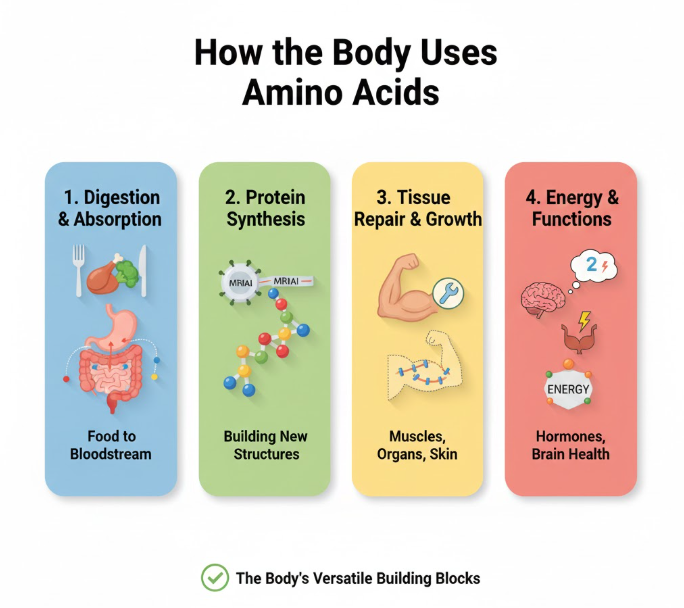
Older Adults
The effects of aging on the body are a change of the way the body processes amino acids. Elderly people require additional protein than younger people in order to keep their body muscles and avoid sarcopenia, the loss of muscle due to age.
Regrettably, a lot of the elderly consume less protein as they lack appetite, have missing teeth, or digestive problems. This is associated with feeling weak, frail, and at risk of falling and fractures.
Sources of Amino Acids
This knowledge on the foods containing amino acids will guide you to make better food choices.
Complete vs. Incomplete Proteins
Whole proteins have all the essential amino acids in proper proportions. Complete proteins are found in animal products such as meat, fish, eggs and dairy.
Incomplete proteins are those with missing one or more of the essential amino acids. Plant foods are mostly incomplete proteins although some, such as soy and quinoa, are complete.
It is not necessary to include all the essential amino acids in each meal. The consumption of various sources of proteins all day is the optimal way to ensure that you make it all.
Protein-Rich Foods
| Food Source | Protein Content (per 100g) | Protein Type |
|---|---|---|
| Chicken breast | 31g | Complete |
| Salmon | 25g | Complete |
| Eggs | 13g | Complete |
| Greek yogurt | 10g | Complete |
| Lentils | 9g | Incomplete |
| Quinoa | 4.4g | Complete |
| Almonds | 21g | Incomplete |
| Tofu | 8g | Complete |
What Does It Feel Like When You Do Not Get Enough?
The protein deficiency is serious in nature although it is not very common in advanced countries.
Amino Acid Deficiency is Characterized by Abnormalities
The first external indicator is muscle wasting. The muscles are broken down in your body to get the amino acids it requires to perform more vital operations.
The swellings, particularly that of the legs and abdomen, are as a result of the liver being unable to produce enough albumin to ensure the necessary fluid balance is maintained.
Immunity is weak, thus exposes you to infections. Wounds take longer time healing, and you fall ill more often.
The loss of hair, brittle nails, thin skin are indicators of failure of the body to support these protein rich structures.
Protein deficiency in children leads to retarded growth, slow development and predisposition to infections.
Protein Malnutrition is Severe
Two types of acute protein-energy malnutrition are kwashiorkor and marasmus. Kwashiorkor is common when the amount of calorie consumed is sufficient but protein is grossly low. Marasmus is caused by protein and calories deficiency.
The two conditions prove to be life threatening and need medical intervention. They mostly impact children within the regions that have limited food access.
Can You Have Too Much?
Although it is a necessity, excess protein may cause issues to certain individuals.
Kidney Stress
Protein diets that are very high cause kidneys to work very hard. In individuals who have already developed kidney disease, this additional load may hasten the damage to the kidney.
Normal healthy kidneys do not have a problem with high protein intake, however, patients with kidney disease need to be cautious of protein intake as advised by the medical personnel.
Digestive Issues
Excessive consumption of protein particularly through supplements may lead to stomach related problems, bloating and constipation.
Protein consumes more water to be metabolized than carbohydrates or fats. A weight loss diet that lacks sufficient fluid consumption may result in dehydration.
Nutrient Imbalance
Excessive focus on protein could be crowded out by other nutrients. A balanced diet consists of the right proportions of carbohydrates, fats, vitamins and minerals on top of protein.
Frequently Asked Questions
How does the body take to use the amino acids post consuming?
Amino acids start getting in to your blood 15-30 minutes after eating and peak levels are 1-2 hours of a meal. They are used by your body in different functions in the subsequent few hours.
Is it necessary that you consume all the necessary amino acids simultaneously?
No, you do not have to have all the necessary amino acids in every meal. It has a free pool of amino acids and as a result of this, you should consume these varied sources of protein in a day and this way, you will have it all.
Does the body have the capacity to stock up on amino acids?
As compared to fat and carbohydrates, your body does not have much storage capacity on the amino acids. Surplus amino acids are either consumed instantly, turned into energy or altered into fat.
Why are more amino acids required by the athletes?
Exercise ruptures muscle fibers, which require mending, stimulates muscle development and raises protein turnover in the body. These processes and enhanced recovery need additional amino acids in order to support athletes.
Are amino acid supplements required?
The amino acid needs of the majority of the population can be met by whole food sources. Supplements can be useful or advantageous to some athletes, those with digestive conditions, or those who have just come out of an illness, but whole foods are also a good source of amino acids and also other important nutrients.
Amino acids in sleep: What is their fate?
During sleep, your body still requires amino acids to repair tissues, work on the immune system as well as hormone production. The protein synthesis and muscle repair is triggered by growth hormone release during deep sleep.
Conclusion
The mechanism of utilizing amino acids by your body is one of the most beautiful systems in nature. Since the time you put protein in your mouth until it is converted to muscles, enzymes and brain chemicals, amino acids are the sources of numerous vital processes.
All your body cells rely on these molecular building blocks. They build your physical framework, control your metabolism, protect you against disease, and your thoughts and even your feelings.
Knowing the way your body utilizes amino acids will enable you to make better diet decisions. Regardless of whether you are a meat eater or a vegetarian, or a relative mixture of both, you can be sure that you are getting enough protein in your diet.
The next time you consume a protein rich meal, you should remember of the incredible trip those amino acids will undergo within your body, and the number of processes that will occur and make you stay healthy, strong and alive.
One of the most effective, yet least complex things to do for your health is to take care of your amino acid needs. These molecules have been working wonders in your body since the time you were born and will do so as long as you live.