The Way Your Body Works Day by Day
The body is like a factory that never rests. There are just millions and millions of little processes that take place in you, every second—that your heart pumps, that your brain thinks, that your muscles move, and that your cells grow. But what is the driving force of all these wonderful things? The solution is in minute molecules known as amino acids and the cluster known as metabolism.
Amino acids are the life alphabet. As you are able to combine 26 letters and create thousands of words, so do you have 20 different amino acids which combine to make thousands of proteins in the body. These proteins are responsible of virtually all activities in your body including fighting infections and digesting the food you take.
In this article, you will find out the working of amino acids with your metabolism to enable to maintain your living and health. We are going to discuss how you digest protein and what happens to it, and we are going to discuss the importance of certain amino acids compared to others. When you are through you will know more about the chemistry of your body than can be expected of most adults.
The Simple Building Blocks: What Amino Acids Are
Amino acids are small organic compounds, which are composed of nitrogen, carbon, hydrogen and oxygen. Proteins are formed as they attach with each other as beads on a necklace. There are 20 different amino acids required in your body.
This is interesting: 11 of these amino acids are manufactured in your body. These are referred to by scientists as the nonessential amino acids. It is not what the name suggests but they are still very important. Nonessential is nothing that you need not acquire with food since your body will make it.
The remaining nine amino acids are termed as essential amino acids. This is something your body cannot produce and therefore you have to obtain them through the foods you consume. This is the reason why a balanced diet is important.
The Essential Nine
The amino acids that you should consume in your diet are these:
- Histidine
- Isoleucine
- Leucine
- Lysine
- Methionine
- Phenylalanine
- Threonine
- Tryptophan
- Valine
The Nonessential Eleven
These amino acids are formed in your body:
- Alanine
- Arginine
- Asparagine
- Aspartic acid
- Cysteine
- Glutamic acid
- Glutamine
- Glycine
- Proline
- Serine
- Tyrosine
Certain amino acids are in a special group termed as conditionally essential. The body normally produces sufficient amounts of them, however, when you are stressed, are ill, or growing very fast, you may have to obtain additional amounts in food.
The Breakdown of Protein in Your Body
When you consume a slice of chicken, a handful of nuts or a bowl of beans, the protein is not consumed directly by your body. It has to first decompose it into separate amino acids. This begins as soon as you put food in your mouth.
The Tour Through Your Digestive System
In the stomach, there is a lot of acid and there are special enzymes known as pepsin. These cut the protein chains into small fragments referred to as peptides. Imagine that it is a long rope being cut into shorter pieces.
The partly digested protein then builds into your small intestine. In this case, more peptide-breaking enzymes are released by your pancreas which decomposes peptides into single amino acids and very short chains of peptides. These amino acids are seized by special transporters of your intestinal walls and taken into your bloodstream.
When in your blood, the amino acids move in your body. Each cell is able to steal what it requires to create new proteins or use them to acquire energy.
Metabolism: The Chemical Factory of Your Body
Metabolism is everything that is occurring to your body currently. It contains two major categories of processes:
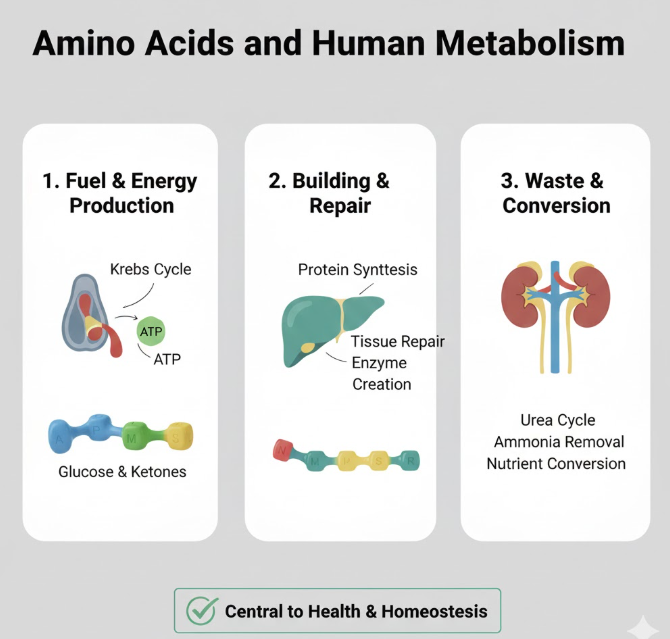
Catabolism decomposes molecules to provide energy. Dismantling amino acids to use as energy is catabolism.
Anabolism is the construction of new molecules with the assistance of energy. That is anabolism when you are making new proteins out of amino acids.
Your metabolism never stops. Your body keeps on breaking down old proteins and constructing others even when you are asleep. Scientists put it at 250 grams of protein that your body recycles each and every day.
The Amino Acid Pool
Your body has a reservoir of amino acids available to it. It is a set of free amino acids that exist at any time at any place in your blood and cells. When you digest protein, your body contributes regularly to this pool and when you are constructing new proteins or producing energy it withdraws.
The size of the pool varies during the day depending on what you consume, and what your body requires. Following a rich protein meal the pool swells. It is reduced during exercise or between meals when your body utilizes amino acids to perform various functions.
Protein Synthesis: How to Build Your Body
Protein synthesis is one of the most significant tasks that metabolism performs—the synthesis of new proteins. Proteins are made by your body at all times since they are worn out and need to be replaced.
How Protein Synthesis Works
The blueprints to all the proteins that your body requires lie in your DNA. Upon the requirement of a particular protein, a cell reads the DNA guidelines and utilizes the amino acids to make the protein bit by bit.
Suppose you have LEGO blocks and you are constructing something. The DNA is your instruction manual. The blocks are amino acids individually. Using the instructions and linking the correct blocks and in the correct sequence, you form a particular structure (protein).
Thousands of various proteins are produced by your body each having its own job:
- Enzymes accelerate the chemical reactions.
- Antibodies fight infections.
- Hormones communicate with the organs.
- Structural proteins make tissues such as skin and muscles.
- Transport proteins in your blood carry nutrients.
Catabolism of Amino Acids into Energy
In a case where your body requires energy, it does not find the necessary carbohydrates or fats, then the body can utilize amino acids to provide energy. This is a complex process compared to the burning of carbs or fats since the amino acids have nitrogen.
Removing the Nitrogen
The nitrogen of your amino group is bound to be taken off by your body before it can use the amino acids as energy. This is referred to as deamination. It occurs predominantly in your liver.
The extracted nitrogen is transformed into a waste by the name urea. Urea passes through your kidneys and it is eliminated in your urine. That is why your urine has nitrogen, it is derived out of decomposed amino acids and proteins.
Once the nitrogen has been removed, the leftover is called a carbon skeleton. This can be broken down to glucose (blood sugar) by a process called gluconeogenesis or it can be broken down further to give energy directly.
When Does Your Body Use Protein?
Your body will favor carbohydrates and fats as a source of energy, leaving amino acids in the role of making proteins. Nevertheless, it will use amino acids as fuel in such cases:
- When one is fasting or starving.
- Very low-carbohydrate diets.
- In extreme or strenuous exercise.
- When you consume excess protein than what is required to make tissues.
Special Functions of Individual Amino Acids
Although all the amino acids aide in the construction of proteins, most of them have additional responsibilities other than building proteins.
Tryptophan: The Mood Maker
Tryptophan is an amino acid that is converted into serotonin in your brain and is used to support mood, sleep and appetite. That is why some people argue that they become sleepy after eating turkey (which is full of tryptophan). But you would have to consume a large quantity of food to ingest a sufficient quantity of tryptophan to have a noticeable effect on the levels of serotonin.
Leucine: The Muscle Builder
Leucine actually tells your muscles to develop and repair following exercise. It triggers the activation of a protein referred to as mTOR which serves as the master switch of muscle protein synthesis. This is the reason why leucine supplements are famous among sportsmen.
Arginine: The Blood Circulator
Arginine turns into nitric oxide, which is what your body uses to relax blood vessels and enhance blood flow. An improvement in the blood flow implies the increased oxygen and nutritional supply of your muscles and organs.
Glutamine: The Immune Supporter
Glutamine nourishes the immune system and regulates the mucus of your bowels. When you are sick or stressed, your body burns a lot of glutamine than the usual one.
Contribution Between Amino Acids and Various Systems of the Body
The amino acids influence almost all the systems of your body. We shall investigate some of the major connections.
Amino Acids and Your Brain
Amino acids are chemicals your brain utilizes to produce neurotransmitters, the chemicals electrically used by brain cells. For example:
- Tyrosine develops to dopamine and norepinephrine, which are influencing factors of motivation and alertness.
- Tryptophan is converted to serotonin, a substance that affects the mood and sleep.
- Glutamate and glycine are directly neurotransmitters.
Low concentration of some amino acids may influence your mood, memory and concentration.
Amino Acids and Your Muscles
Muscles are primarily composed of protein especially two proteins known as actin and myosin. Muscle fibers develop little tears when you exercise. These tears are repaired to form new proteins which make the muscles stronger and bigger in your body.
The branched-chain amino acids (BCAAs): leucine, isoleucine, and valine are particularly significant to muscle metabolism. The BCAAs can be utilized by the muscles directly as energy or to create new proteins unlike the other amino acids which are processed in the liver first.
Amino Acids and Your Immune System
Amino acids are very essential to your immune system. Proteins produced by using amino acids are antibodies that combat infections. The white blood cells require energy and growth in an amino acid. When you are ill, your body will accelerate protein breakdown in order to provide additional amino acids in your immune system.
How Much Protein Do You Need?
The quantity of protein required is affected by various factors such as the age, level of activity and health among others.
General Recommendations
Among adults, it is suggested by the experts that two adults should have approximately 0.8 grams of protein per kilogram of body weight daily. That is approximately 56 grams of protein a day in the case of an individual of 70 kilograms (154 pounds).
But there are others who require more:
- Teenagers require more protein as they are growing.
- Athletes should have more to rebuild and develop muscles.
- Pregnant women require extra protein to feed the baby.
- Older adults might require additional preventive measures that will inhibit muscle wasting.
- Individuals recuperating after a disease or surgery require an increase of protein in order to heal.
Symptoms of Lack of Sufficient Protein
Your body will give you the sign whether you are not getting enough protein:
- Hair becomes finer or loses excessively.
- Nails break easily.
- You feel weak or tired often.
- Wounds heal slowly.
- You get sick frequently.
- You lose muscle mass.
Complete vs. Incomplete Proteins
Not every source of protein is the same. There are foods that have all the nine essential amino acids in good quantities. These are referred to as complete proteins. Other food items do not contain all the essential amino acids. These are incomplete proteins.
Complete Protein Sources
- Any animal produce (meat, fish, eggs, dairy)
- Soy products (edamame, tofu, tempeh)
- Quinoa
- Buckwheat
- Hemp seeds
- Chia seeds
Incomplete Protein Sources
- Most beans and legumes
- Grains
- Nuts
- Seeds (except hemp and chia)
- Vegetables
Even with vegan or vegetarian diet, you can obtain all the necessary amino acids by taking various plant based proteins throughout the day. As an example, rice is deficient in lysine and is in abundance in methionine and beans are rich in lysine and are low in methionine. Combining the two sources of protein provides you with all the essential amino acids.
Table of Complementation of Proteins
| Food Combination | Their Interaction |
|---|---|
| Rice + Beans | Grains complete the amino acid profile of each other. Beans provide lysine, which rice does not have, and rice provides methionine, which beans do not have. |
| Peanut butter + Whole wheat bread | Completely different in their amino acids. |
| Hummus + Pita | Complete each other with lysine and methionine respectively. |
| Tofu + Quinoa | They are complete proteins, so provide an excellent variety. |
What Would Happen With The Amino Acid Metabolism?
The way of how the body works with the amino acids is sometimes not perfect. These are normally genetic and inborn.
Phenylketonuria (PKU)
PKU patients are unable to metabolize the necessary amino acid, phenylalanine. When the level of phenylalanine accumulation in the blood increases it may lead to brain damage. In most countries, PKU is tested at birth on the babies. Individuals affected with PKU are required to adhere to special low-phenylalanine diet all their lives.
Maple Syrup Urine Disease
The condition is a rare one in which the body is not able to process three amino acids namely leucine, isoleucine, and valine. It is named so because the urine of the affected babies smells of maple syrup. These amino acids are toxic and can build up without treatments resulting in severe health complications.
Homocystinuria
In this state, the body is not able to process methionine in the right manner and the homocysteine accumulates in the blood. The high levels of homocysteine may cause vision disabilities, blood clots, skeletal complications, and developmental delay. The therapy is normally in the form of diet and vitamin supplements.
Amino Acid Supplements: Does One Need Them?
Amino acid supplements can be found everywhere, on the shelves of every nutrition store. But do you really need them?
Who May Be Affected by Supplements
The majority of the population obtains all the necessary amino acids through foodstuff. Nevertheless, supplements could be useful in certain cases:
- Athletes that want to build muscle or enhance performance.
- Individuals who have undergone surgery or serious diseases.
- Elderly people who have a problem with consuming sufficient protein.
- Individuals affected by some medical conditions that influence the absorption of proteins.
- Vegetarians or vegans who find it hard to find sufficient diversity in their food.
The Issue of Supplements
Amino acid supplements are not cheap and studies on its advantages are inconclusive. Amino acids are available in whole foods, which provides you with other valuable nutrients as well: vitamins, minerals, fiber, and healthy fats.
Also, the consumption of large quantities of separate amino acids may cause imbalances. Your body is conditioned to use amino acids in the ratio of those in food not in megadose.
The Best Way to Be Amino Acid Maximizing
A healthy amino acid metabolism can be supported in a few ways that are related to lifestyle.
Consume Protein in Small Portions All Day Long
Eat your protein with meals and snacks rather than having one large dinner meal. The amount of protein that your body can utilize at a time in building up muscle is approximately 25-30 grams. The remaining is utilized to provide energy or otherwise. Most protein foods eaten every few hours will keep the levels of amino acids in your blood steady.
Protein and Exercise Combination
Workout provides the message to your body to develop new proteins. The consumption of protein after exercising will make your body more efficient in utilizing those amino acids in order to rebuild and develop muscle tissue.
Stay Hydrated
Water is needed in many metabolic processes such as the amino acid metabolism. Dehydration may reduce the rate of such processes and decrease the efficiency of your body to utilize the consumed protein.
Get Enough Sleep
Most of your repair and building is done when you are asleep. Sleep deprivation may disrupt the process of protein synthesis and muscle healing. Strive to attain 7-9 hours of sleep per night.
Manage Stress
Chronic stress elevates cortisol which is a hormone that triggers the breakdown of protein. Exploring effective stress management methods is a good way to maintain your muscle mass and aid in effective amino acid metabolism.
What Lies Ahead of Amino Acid Research
Amino acids and metabolism keep on being discovered by scientists. Existing fields of research are:
Personalized Nutrition: Scientists are examining the influence of personal genetic variation on amino acid requirements. It is possible that in the future, you will receive a tailor-made protein recommendation due to your DNA.
Amino Acids and Aging: Researchers are exploring the potential of age to be slowed using definite amino acids or can age be stopped in terms of muscle loss. There are some studies which indicate that leucine supplements could be beneficial in helping older adults by taking care of the muscle mass.
Amino Acids and Disease: Amino acid metabolism is being studied in relation to disease such as cancer, diabetes and heart disease. The knowledge of these relationships could result in new therapies.
Sports Performance: Scientists are still researching on the effects of various amino acids on athletic performance, recovery and muscle building. This study assists sportsmen in the optimization of nutrition.
Frequently Asked Questions
Q: Can I get too much protein?
A: Although your body may tolerate relatively high amounts of protein, excessive amounts in the long run may put a strain on your kidneys and liver. The majority of specialists propose not to exceed two times the recommended daily intake of protein unless there are certain chances of sports or medical necessity to consume higher.
Q: Are animal proteins superior to the plant proteins?
A: Animal proteins are full proteins and tend to be simply digested. Nevertheless, plant proteins are also quite healthy with a diversity of consumption. Plant proteins are fortified with favorable fiber and other nutrients that are not found in animal proteins.
Q: Should I consume protein right after an exercise?
A: The anabolic window is not that thin as it was previously believed. Although it is good to consume protein within a few hours after exercise, it does not really matter on how much protein is taken but sufficient protein is consumed within the day.
Q: Will amino acid supplements assist me in shedding off weight?
A: Some studies indicate that protein and some amino acids may aid in losing weight by making people feel full and maintain muscle mass when the calorie content is limiting. Nevertheless, the protein sources of the whole food are more efficient and healthier than supplements.
Q: My urine smells oddly when I consume large quantities of protein, why?
A: During the breakdown of excess amino acids by your body, it produces an increased amount of urea and other compounds that contain nitrogen and are removed by your kidneys into urine. This has the ability of altering the smell of urine particularly when one is not taking an adequate amount of water.
Q: Are BCAAs worth the money?
A: For most people, no. You will see that you get plenty of BCAAs naturally as long as you consume sufficient protein out of whole foods. They could be giving minor favors to serious athletes in high training, but this evidence is inconclusive.
Putting It All Together
The relationship between the amino acid and the human metabolism is a beautiful dance that will keep you alive and healthy. On a daily basis, your body breaks the proteins ingested down, takes the amino acids to construct new proteins and burns some of these to provide energy where necessary.
The knowledge of this process can assist you make improved decisions regarding what you consume and in what way to live. You do not have to spend a lot of money on supplements and complex diets. Pay attention to the consumption of a diverse range of protein sources, physical activity, sleep quality, and stress reduction.
Your body is very intelligent. Provide it with the raw material it requires, i.e. those 20 amino acids of various protein sources, and it will do the rest. Whether you are a sports person aiming to gain some muscle, a student aiming at being more alert, or even an ordinary person who looks forward to better health, it is one of the best investments you can make in your health to support your amino acid metabolism by eating well.
Keep in mind, no cell in your body does not need amino acids. They are not the building blocks of muscles, but of your brain, immune system, hormones and pretty much all the biological processes. Be kind to them through making considerate food selections and your body will pay you back by giving you improved health, more energy and performance in any activity you undertake.