
This is the reason why your muscles should be replenished with amino acids after working out
Feeling an amazing state after a difficult exercise. There are teeny-weeny tears in your muscles, you are low in energy levels and your body is screaming of nutrients. When amino acids are your best friend.
Amino acids can be thought of as building blocks, such as LEGO pieces. These pieces are used to rebuild and repair muscles after exercise by your body. You cannot have enough of these building blocks, and your muscles cannot be able to recover. You may also be sore days, lose muscle not gain it or also feel tired and weak.
This period of time (30-60 minutes) following exercise is called the anabolic window. It is a period when your muscles are like sponges, which are willing to absorb nutrients. Getting your body the appropriate amount of amino acids at this stage can be the difference between how fast it will be back on the feet and how powerful it is going to be.
What are Amino Acids and What is their Importance?
Proteins are small molecules that bind together to make up amino acids. Everything, be it muscles, skin, hormones is made by your body using 20 different amino acids. Of these 20, nine are referred to as essential since they cannot be produced internally in your body. They need to be obtained through food or supplements.
Muscles are broken down when you work out, particularly with weights or with vigorous cardio activities. This destruction is natural and in fact required to grow. However, your muscles require to reconstruct that protein, and it requires amino acids to accomplish it, after the workout.
This is what the recovery process entails:
- Exercise tears tiny holes in your muscle fibers which are repaired
- Muscles make your body build new muscle protein
- The storage tanks of your energy are replenished
- The pain and swelling begin to subside
These mechanisms cannot take place without amino acids. For a comprehensive understanding of how amino acids work in your body, explore detailed guides on amino acid functions and benefits.
There are three most essential amino acids that aid in recovery
Leucine: The Muscle Builder
The superstar of the post-workout nutrition is leucine. This amino acid directly communicates to your muscles the initiation of a new building of protein. It is as though you are turning on a switch that is informing your body, “Time to grow!”
It has been found out that leucine is approximately 10 times more effective in stimulating muscle growth as compared to other amino acids. To promote the recovery process, it is possible to intake 2-3 grams of leucine after a workout.
Foods such as chicken breast, eggs, milk and soybeans contain leucine. Lots of protein powders also emphasize the presence of leucine in them since it is of such great value.
Isoleucine: The Power Rejuvenator
The Isoleucine assists your muscles in using energy to recover. It also helps in controlling blood sugar and enhancing your immune system in case the hard work you did weakens your immune system.
In the case whereby, after a work out; your muscles are drained, isoleucine assists in taking glucose (sugar) into muscle cells where it can be utilized to generate energy and regenerate. This amino acid goes to work in the background, and it enhances the leucine muscle-building.
Valine: The Fatigue Fighter
Valine assists in mitigating mental fatigue and maintains the energy levels constant in the process of recovery. It also interacts with leucine and isoleucine in repairing muscle tissue.
These three amino acids, namely leucine, isoleucine and valine, are referred to as branched-chain amino acids (BCAAs) due to their chemical structure. They work best as a team.
The BCAAs can be found in working collaboration in your body
In your muscle protein, leucine and isoleucine are essential amino acids that are composed of BCAAs, approximately 35 percent of the essential amino acids. When you consume them after exercise they bypass your liver and directly go to your muscles. This implies that they begin working in a faster rate than other amino acids.
This is a simplistic description of how it works:
Right After Exercise (0-30 minutes):
- BCAAs get into your blood fast
- Signal of leucine makes muscles begin to build up again
- The breakdown of muscle protein is slowed down
30 Minutes to 2 Hours:
- There is a great increase in muscle protein synthesis
- The valine and isoleucine aid in energy replenishment
- Recovery processes speed up
2 to 24 Hours:
- Further muscle repair and development
- Reduced soreness develops
- Strength reinvigorates to normal levels
Other Amino Acids that are necessary towards post-workout recovery
Although BCAAs receive the greatest reviews, other amino acids are essential as well.
Glutamine: The Supporter of Immune System
Vigorous work has a short-lived effect of undermining your immunity. Glutamine not only aids in a recovery of the immune system, it also promotes the health of the gut, which is essential since the engine of getting through the digestive system absorbs all those nutrients that you feed on to recover.
With vigorous exercises, the level of glutamine may decrease up to 50 percent. One of the ways to replenish these levels is to take 5 to 10 grams of glutamine after the workout.
Arginine: The Blood Flow Booster
Arginine assists in the creation of nitric oxide by your body which dilates blood vessels. The improved flow of blood results in faster delivery of oxygen and nutrients to your muscles accelerating the recovery process.
Lysine: The Collagen Creator
Lysine assists your body in the production of collagen, which is important to the healthy tendons, ligaments, and connective tissue. When you limit your attention on the muscles and neglect the connective tissue then you are likely to be injured.
Complete vs. Incomplete Sources of Protein
Protein sources do not include all the essential amino acids. This is important to your post exercise nutrition.
Complete Proteins (have all nine essential amino acids):
- Animal products: beef, fish, eggs, milk products, chicken
- Soy products: tofu, tempeh, edamame
- Quinoa
- Buckwheat
Incomplete Proteins (one or more missing essential amino acids):
- Most beans and legumes
- Nuts and seeds
- Most grains
- Vegetables
When you consume incomplete proteins, it is necessary to add them in a strategic manner. Indicatively, beans and rice contain all the necessary amino acids as a combination. Particularly, this is critical to vegetarians and vegans.
Timing Your Intake of Amino Acid to get the Best result
The old rule was easy: eat a kind of protein in half an hour after exercising. With the new findings of the window, the window is longer than we imagined, but we should not delay.
The Optimal Timeline
Right after exercise until 30 Minutes Later: This is prime time. To take up nutrients, your muscles are ready. Target protein with at least 20-40 grams with at least 2-3 grams of leucine.
30 Minutes to 2 Hours: Still very effective. Unless you caught it right away, there is nothing to worry about. The amino acids will be utilized in your body because it is still on the recovery mode.
2 to 4 Hours: Positive yet not as important. Muscles are still on recovery and therefore every meal counts within the next 24-48 hours.
Pre-Workout Nutrition is also important
Presence of amino acids in your organism prior to exercise can even enhance recovery. Consuming protein 1 to 2 hours prior to exercise is sufficient to get the amino acids in your blood before you are done.
What is the Real Requirement of Protein and Amino Acids?
The quantity will depend on the following aspects: your weight, the intensity of the workout, and fitness objectives.
General Guidelines:
| Goal | Protein Post-Workout | Leucine Content |
|---|---|---|
| Maintain muscle | 0.14-0.23 grams per pound body weight | 1.5-2 grams |
| Build muscle | 0.23-0.36 grams per pound body weight | 2-3 grams |
| Weight loss (preserve muscle) | 0.14-0.27 grams per pound of body weight | 1.5-2.5 grams |
Example: A 150 lb individual who wants to gain muscle mass requires 35 to 55 grams of protein after exercise.
Top sources of post-exercise Amino acids
Natural food usually outweighs supplements. Here are top choices:
Animal-Based Options
Chicken Breast (4 ounces):
- 35 grams protein
- 2.8 grams leucine
- Quick to digest
Greek Yogurt (1 cup):
- 20 grams protein
- 1.8 grams leucine
- Probiotics to take care of the gut
Eggs (3 large):
- 18 grams protein
- 1.6 grams leucine
- Rich in other nutrients
Salmon (4 ounces):
- 25 grams protein
- 2.1 grams leucine
- Contains anti-inflammatory oils
Plant-Based Options
Tofu (1 cup):
- 20 grams protein
- 1.5 grams leucine
- Complete protein source
Protein-Rich Smoothie:
- Blend: 1 cup soy milk (8g protein) + 2 tablespoons peanut butter (8g protein) + 1 banana + a handful of spinach
- Total: about 16 grams protein
Lentil and Rice Bowl:
- 1 cup cooked lentils + 1 cup brown rice
- 25 grams protein when combined
- Complete amino acid profile
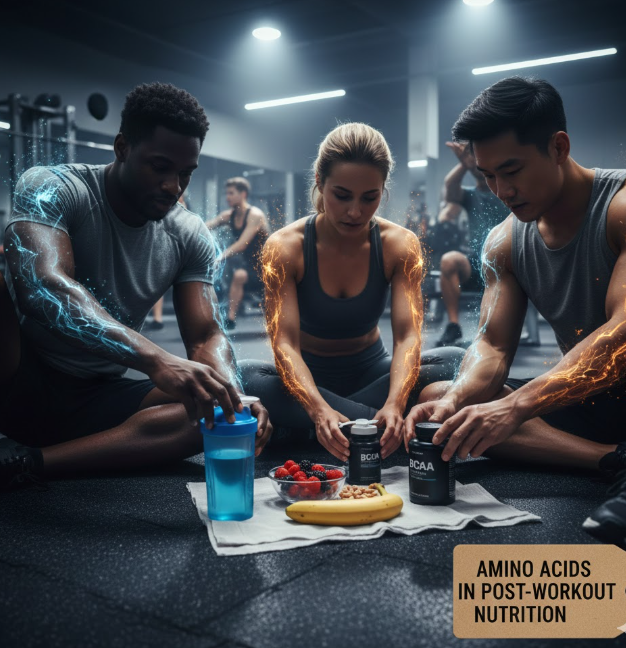
Supplements: When and When Not to Take them
Supplements are not obligatory but convenient. Here’s when they make sense:
BCAA Supplements
Best For:
- Having empty stomach training
- Multiple daily workouts
- Vegetarians with protein deficiency problems
Skip If:
- You already take sufficient complete protein
- Protein powder (BCAAs) is present
Whey Protein Powder
Advantages:
- Rapid absorption (to muscles in 30 minutes)
- Large amount of leucine (around 3 grams in 25-gram portion)
- Convenient and portable
Disadvantages:
- Not suitable for people with dairy allergies
- Costly compared to food sources
- Some products include artificial ingredients or added sugar
Plant-Based Protein Powders
Vegans can use pea, rice, and hemp protein powders. Seek combinations where you combine a number of sources so that you get all the necessary amino acids.
Common Mistakes That Hurt Your Recovery
Waiting to eat
Others take hours before they eat even after an exercise. Although the anabolic window is not shorter than 30 minutes, delaying it (more than 2 hours) will result in slower recovery.
Under-consumption of total protein
Protein consumed after the workout is important, however, so is the amount you take daily. Make a target of 0.7-1 gram of protein per pound of body weight daily.
Ignoring Carbohydrates
Amino acids are more effective when they are combined with carbs. Insulin which aids in pushing amino acids to the muscle cells spikes due to carbohydrates. Carbs to protein ratios of 3:1 or 4:1 are suitable for the majority of individuals.
Taking BCAAs Instead of Complete Protein
BCAAs do not include all the building blocks that your muscles need. Complete protein sources are just about always better.
Special Considerations for Different Types of Athletes
Strength Training and Bodybuilding
Protein is needed the most in muscle building. Pay attention to sources that include leucine and strive to meet the upper protein guidelines (0.3-0.4 grams/lb after exercise).
Endurance Training
Long runs or bike rides exhaust the muscle protein and glycogen (stored carbs). Good balance of amino acids and carbohydrates is required in endurance athletes in order to recover.
CrossFit and High-Intensity Interval Training
These exercises are a combination of strength and endurance, and hence, the recovery nutrition must consist of high protein (having all essential amino acids) and carbohydrates.
Preparing Your Ideal Post-Workout Meal
The following simple formula applies with most people:
Step 1: Select a source of protein that contains all essential amino acids (20-40 grams)
Step 2: Add carbohydrates (50-100 grams, based on the intensity of the workout)
Step 3: Add a little bit of healthy fat (not a mandatory step but a good idea)
Example Meals:
Quick Option:
- Protein shake with 1 banana and 1 tablespoon almond butter
Home-Cooked Meal:
- Baked chicken breast with sweet potato and grilled broccoli
Vegetarian Choice:
- Quinoa bowl with black beans, avocado and vegetables
On-the-Go:
- Greek yogurt with berries and granola
Frequently Asked Questions
Q: Can I simply eat normal food as opposed to taking supplements?
A: Absolutely! Whole foods contain amino acids and other useful nutrients such as vitamins, minerals and fiber. Supplements are not needed and convenient in case you consume balanced meals.
Q: Do I really need to take BCAAs when I am already taking protein powder?
A: Probably not. All BCAAs are already present in protein powder. Additional BCAAs will be of no extra benefits in the majority of the cases.
Q: What is the interval to expect improvement in better post-workout nutrition?
A: You will feel less sore within days up to one week. It requires 4 to 8 weeks of training and nutrition for noticeable muscle growth.
Q: Can one consume excessive protein after a workout?
A: The body can at most use approximately 20 to 40 grams of protein at a time in the process of building muscle. Increased intake will not be detrimental but the additional will not accelerate recovery. Eat small portions of protein throughout the day.
Q: What about working out late in the night?
A: Do not forget to have your post-workout meal. Sleep is the time when recovery takes place and therefore it is not harmful to have amino acids before sleep.
Q: Are amino acid supplements safe?
A: For most healthy people, yes. Nevertheless, patients with kidney disease are recommended to visit the doctor prior to consuming excessive quantities of protein or amino acid supplements. According to the National Institutes of Health, proper protein intake is generally safe for healthy individuals when consumed within recommended limits.
Making It Work in Real Life
It is one thing to know amino acids and another thing is to utilize this knowledge all the time. Here are practical tips:
Meal Prep Sunday: Prepare multiple portions of protein foods (chicken, turkey, tofu) which can be nuked in the microwave after exercise.
Backup Plans: Have protein powder, Greek yogurt, or even protein bars on hand to use on the days when you do not have time to make a full meal.
Monitor Your Diet: Have a simple food diary over one week and you will be able to determine whether you are getting enough protein not just after exercise.
Listen to Your Body: When you are always sore, dragged, or not getting improvement, then you are likely to require more protein and amino acids.
The Final Word on Amino Acids and Recovery
Amino acids are required in muscle building, reduction of soreness, and gaining strength following exercises. Although the science may become a complex matter, the practical implementation is quite simple: one should consume 20 to 40 grams of complete protein over a few hours following a training session and, ideally, with some form of carbohydrate.
The BCAAs, leucine in particular, are the most popular in muscle recovery, yet they are most effective in whole protein sources. The real food has it all, and supplements may be handy when you are not in time.
It is important to remember that post-workout nutrition is only one of the pieces of the puzzle. The amount of protein you consume on a daily basis, the quality of your sleep, exercise regime and your diet are all contributing factors to your outcomes. Consistency is far better than perfection. Consuming the correct amino acids following the majority of the workouts will be more effective than the occasional consumption of the ideal recovery meal.
Your muscles are constantly breaking down and rebuilding. Provide them with the building blocks of amino acids and they will reward you with quicker healing, reduced pain as well as consistent advancement on your fitness journey.