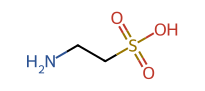
Taurine is an amino acid with a sulfonic acid group in place of the usual carboxyl group, and for that reason it is not built into proteins [1]. It is nevertheless one of the most abundant free amino acids in the body. It is found in almost every tissue, with the highest levels in the retina, heart, brain and muscles, and most of the body’s taurine is in skeletal muscle [1].
The body makes taurine from cysteine and also takes it from meat and seafood. For cats it is an essential nutrient; for humans it is considered conditionally essential [2]. Taurine is added to infant formula and energy drinks and sold as a supplement, but the European Food Safety Authority has found none of the health claims made for it to be established [3] [4].
| Formula | C2H7NO3S [5] |
|---|---|
| Molar mass | 125.15 g/mol [5] |
| Made in the body from | Cysteine [3] |
| Used in proteins | No [1] |
| Typical intake from food | 40–400 mg a day [6] |
Discovery of taurine
Taurine was discovered in 1827 by the German scientists Friedrich Tiedemann and Leopold Gmelin [2]. It was first isolated from the bile of the ox, Bos taurus, and is named after it [7].
For a long time its role was unclear. A clue came from cats. In 1975 Hayes, Carey and Schmidt at Harvard reported that kittens and adult cats fed a diet with casein as the source of protein developed degeneration of the retina within three months. Their plasma contained almost no taurine, although the other amino acids, including methionine and cystine, were normal. Casein is low in sulfur amino acids, and the cat liver, unlike that of the rat or dog, can convert little cysteine sulfinic acid to taurine [8]. In 1987 Pion and colleagues at the University of California, Davis, linked low plasma taurine to dilated cardiomyopathy, a heart disease that killed thousands of pet cats each year. All 23 cats with the disease that they examined had low plasma taurine except one. Cats given 0.5 g of taurine twice a day improved within weeks, and the 17 treated cats that they followed for 10 to 26 weeks were alive and clinically normal, whereas 85% of cats diagnosed with the disease in earlier years had died [9].
Chemical structure of taurine
Taurine is 2-aminoethanesulfonic acid. It has a chain of two carbon atoms with an amino group at one end and a sulfonic acid group (–SO3H) at the other [7]. The amino group is on the β-carbon, so taurine is a β-amino acid [2], and it has no stereocentre, so it has no L and D forms. Because the sulfonic acid group is a very strong acid, it is always ionised in water, and in the body taurine exists as a zwitterion with no net charge [2] [5].
Taurine is related to cysteine, from which it is made: removing the carboxyl group of cysteine and fully oxidising its sulfur gives taurine [3]. Industrially it is made by chemical synthesis, from monoethanolamine and sulfuric acid, or from ethylene oxide [6].
Chemical and physical properties of taurine
| IUPAC name | 2-Aminoethane-1-sulfonic acid |
|---|---|
| Formula | C2H7NO3S [5] |
| Molar mass | 125.15 g/mol [5] |
| Monoisotopic mass | 125.0147 Da (calculation) |
| SMILES | NCCS(=O)(=O)O |
| InChI | InChI=1S/C2H7NO3S/c3-1-2-7(4,5)6/h1-3H2,(H,4,5,6) |
| InChIKey | XOAAWQZATWQOTB-UHFFFAOYSA-N |
| CAS Registry Number | 107-35-7 [10] |
| MDL number | MFCD00008197 |
| Melting point | 328 °C [5] |
| pKa (SO3H; NH3+), 25 °C | −0.3; 9.06 [5] |
| Solubility in water, 25 °C | 105 g per kg of water [5] |
Taurine forms monoclinic prisms when crystallised from water [10]. The pKa of its sulfonic acid group is below zero, compared with about 2 for the carboxyl group of ordinary amino acids [5].
How the body makes taurine
Mammals make taurine from cysteine, which can in turn be made from methionine. Cysteine dioxygenase first oxidises the sulfur of cysteine, giving cysteine sulfinic acid. Cysteine sulfinic acid decarboxylase then removes the carboxyl group to give hypotaurine, and hypotaurine is oxidised to taurine. The enzyme for this last step was assigned in 1962 but identified only in 2020, as flavin-containing monooxygenase 1. In adult humans this enzyme is hardly expressed in the liver, which may explain why humans make less taurine than rodents. A second, minor route makes hypotaurine from cysteamine released when coenzyme A is broken down [1].
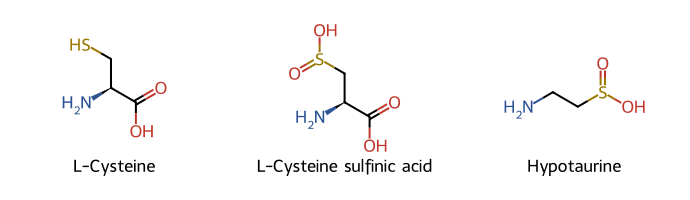
The decarboxylation step limits the rate of synthesis [3]. Mammals cannot break taurine down: it is excreted unchanged in the urine or used by the liver to make bile salts [1]. When intake is low, as in vegans, the body adapts by conjugating more bile acids with glycine instead of taurine, slowing taurine turnover and excreting less in the urine. Tissue levels, particularly in the brain, depend little on intake [3].
Functions of taurine
Bile salts
The best-known role of taurine is in bile. The liver joins it to bile acids to form bile salts [7] [1], which help the intestine absorb fats [2].
Cell volume
Taurine is one of the main organic osmolytes, the small molecules that cells use to control their volume. Cells take it up through a sodium- and chloride-dependent transporter, TauT, and release it through a pathway that opens when they swell [1] [7].
Mitochondria
Taurine is a building block of two modified bases in mitochondrial transfer RNAs, 5-taurinomethyluridine and 5-taurinomethyl-2-thiouridine. These modifications stabilise the pairing of codon and anticodon and are needed to make the proteins encoded by mitochondrial DNA. In MELAS, an inherited mitochondrial disease, mutant transfer RNAs lack the taurine modification [1].
Nervous system and retina
Taurine is one of the most abundant amino acids in the brain and the retina; in the rat eye it is the most abundant amino acid in the retina, lens, cornea and other tissues [7]. Without taurine, photoreceptors degenerate, as in cats fed taurine-free diets and in mice lacking the taurine transporter [7]. In the nervous system taurine dampens the firing of neurons and acts as a weak agonist at GABAA, glycine and NMDA receptors [2]. It meets most of the criteria for a neurotransmitter, but no receptor specific to taurine has been found in vertebrates [7].
Is taurine an antioxidant?
Taurine is often called an antioxidant, but at the concentrations found in most tissues it is a poor direct scavenger of reactive oxygen species. Its precursors hypotaurine and cysteamine do much better. In neutrophils, a type of white blood cell, taurine reacts with hypochlorous acid, a strong oxidant they produce, to form taurine chloramine, which damps inflammation in cell studies [1].
Is taurine essential?
For cats it is. Cats make very little taurine and must use it to conjugate bile acids, so a diet short of taurine depletes their tissues [9]. Humans also make little taurine, but they retain it better than cats and rarely show signs of deficiency, although it can occur during long-term intravenous feeding [2]. Because synthesis and normal intake may not meet the body’s needs in some conditions, taurine is classed as conditionally essential, particularly for preterm infants [3]. It is added to many infant formulas and intravenous nutrition solutions [1].
Vegans eat almost no taurine and have lower plasma levels, but no symptoms of taurine deficiency have been reported in them [1].
Taurine and aging
In 2023 Singh and colleagues reported in Science that blood taurine falls with age in mice, monkeys and humans; in their human samples older people had more than 80% less taurine than younger ones. In middle-aged mice given 1000 mg of taurine per kilogram a day, median life span increased by 10 to 12%, and middle-aged monkeys given taurine for six months had better measures of health. In 11,966 people from the EPIC-Norfolk study, lower levels of taurine and related metabolites were associated with obesity, type 2 diabetes and inflammation. The authors concluded that taurine deficiency may be a driver of aging and called for clinical trials in humans. Columbia University has filed provisional patent applications that name the senior author, Vijay Yadav, as an inventor [11].
In 2025 a team at the US National Institute on Aging challenged the premise. Fernandez and colleagues measured taurine repeatedly over the years in the same individuals: 742 people aged 26 to 100, rhesus monkeys and mice. Blood taurine rose or stayed the same with age in all groups, and differences between individuals were larger than the changes with age. Taurine was not consistently related to muscle strength or body weight. They concluded that low blood taurine is unlikely to be a good marker of aging. They noted that the decline reported in 2023 came from a pooled analysis of people aged 0 to 60, and that other studies had found plasma taurine to fall by about a quarter between childhood and adulthood [12].
No trial has yet shown that taurine slows aging in humans. The mouse dose used by Singh and colleagues corresponds to about 6 g a day for a 70 kg adult [1].
Taurine supplements
What the European assessment found
Between 2009 and 2011 the EFSA panel on nutrition assessed claims that taurine protects cells from oxidative damage, supports energy metabolism, delays fatigue and improves physical performance, protects the immune system, supports cognitive function and maintains normal heart and muscle function. For every claim it either found the claimed effect too vaguely defined or concluded that a cause-and-effect relationship had not been established [3] [4]. Many of the human studies submitted had tested energy drinks that also contained caffeine, so the effect of taurine alone could not be judged. The only study of taurine alone on exercise had 11 young men and no control group [3] [4].
Blood pressure, glucose and lipids
Most of the human trials concern cardiovascular and metabolic risk factors. A 2024 meta-analysis by Tzang and colleagues pooled 25 randomised trials with 1,024 participants, who took 0.5 to 6 g of taurine a day for 5 to 365 days. They included healthy people and patients with heart failure, diabetes, obesity and other conditions. Compared with control groups, taurine lowered systolic blood pressure by about 4 mmHg, diastolic pressure by 1.5 mmHg, fasting glucose by 5.9 mg/dl and triglycerides by 18 mg/dl, but did not change HDL cholesterol or body weight. Adverse effects were no more common than with control treatments [13]. The trials were small and varied, results for systolic pressure differed widely between them, and 18 of the 25 did not report how treatment allocation was concealed [13]. The study was funded by Taiwanese public and hospital grants, and the authors declared no competing interests [13].
Medical uses
In Japan taurine is registered as a medicine. Its approved uses are improving liver function in hyperbilirubinaemia (other than obstructive jaundice), congestive heart failure, and preventing stroke-like episodes in MELAS. In heart failure the dose is 1 g three times a day, given together with cardiotonic and diuretic drugs when these alone are not effective enough. The label summarises a double-blind comparative trial in 45 patients with heart failure, in which 26.7% showed moderate or greater improvement after 6 weeks of 3 g a day, but it does not give the result in the comparison group [14]. When EFSA assessed a claim that taurine maintains normal heart function, the only human study submitted was an uncontrolled study of 10 patients with heart failure, and the panel found that no conclusion could be drawn from it [4].
The use in MELAS rests on the taurine modification of mitochondrial transfer RNA, which is missing in the disease. In a multicentre open-label trial in Japan, 10 patients with recurrent stroke-like episodes took 9 or 12 g of taurine a day for 52 weeks. Six had no stroke-like episodes during the evaluation period, and in eight the frequency fell by at least half. Six patients had mild or moderate side effects attributed to taurine, and none stopped treatment. The trial had no placebo group, and nine of the ten patients had received L-arginine before it. It was funded by Japanese government research grants, and Taisho Pharmaceutical supplied the taurine [15]. The Japanese label also reports results from a phase III trial in ten patients with MELAS [14].
This section summarises research. It is not medical advice.
Safety and energy drinks
In a survey of the Austrian market, most energy drinks that declared taurine contained 4000 mg per litre, so a 250 ml can contains about 1 g, together with caffeine. In 2009 the EFSA panel on food additives assessed taurine at these levels, assuming an average intake of half a can a day and a high intake of 1.4 cans. In rats, 1000 mg of taurine per kilogram a day for 13 weeks caused no tissue damage, and 1500 mg/kg caused no changes in behaviour. That dose is 120 times the average and 43 times the high intake from energy drinks, and the panel concluded that taurine at these levels is not of safety concern. It did not assess the safety of energy drinks as such, and it considered that adverse effects described in recent case reports could be due to caffeine, while a causal role of taurine lacked scientific evidence [6]. In clinical studies, patients took 3 to 6 g of taurine a day for up to a year without adverse effects, although the studies were not designed to look for them [6].
Taurine taken by mouth is absorbed quickly and any excess is excreted by the kidneys. In rats, daily doses for two weeks did not raise the amount of taurine in the brain [6].
Food sources of taurine
Taurine occurs naturally in foods of animal origin and is practically absent from plant foods [3]. Seafood is the richest source, with up to about 830 mg per 100 g; dark poultry meat has about 340 mg, other poultry 30 to 40 mg and dairy products only 2 to 8 mg per 100 g [1]. One study estimated the average intake from an omnivorous diet at about 58 mg a day, ranging from 9 to 372 mg, and the intake from a strict vegetarian diet as low or negligible; another put typical intakes at 40 to 400 mg a day [6].
In short
- Taurine is 2-aminoethanesulfonic acid, a β-amino acid with a sulfonic acid group that is not used in proteins.
- It was isolated from ox bile in 1827; in the 1970s and 1980s its deficiency was shown to cause retinal and heart disease in cats.
- Humans make it from cysteine and get it from meat and seafood; it forms bile salts, controls cell volume and modifies mitochondrial transfer RNAs.
- The claim that taurine falls with age and drives aging is disputed.
- EFSA did not substantiate the health claims it assessed; clinical trials suggest small reductions in blood pressure, fasting glucose and triglycerides, and taurine at energy-drink levels is not considered a safety concern.
- In Japan taurine is a registered medicine for heart failure, a liver indication and stroke-like episodes in MELAS.
References
- Beine BJ, Castellano M, Fiamoncini J, Hiller K. Taurine supplementation at the crossroads of metabolism, inflammation and aging: mechanistic and nutritional perspectives. Food & Function 17:5880–5904 (2026). https://doi.org/10.1039/d6fo01808d
- Schaffer S, Kim HW. Effects and mechanisms of taurine as a therapeutic agent. Biomolecules & Therapeutics 26(3):225–241 (2018). https://doi.org/10.4062/biomolther.2017.251
- EFSA Panel on Dietetic Products, Nutrition and Allergies (NDA). Scientific Opinion on the substantiation of health claims related to taurine and protection of DNA, proteins and lipids from oxidative damage (ID 612, 1658, 1959), energy-yielding metabolism (ID 614), and delay in the onset of fatigue and enhancement of physical performance (ID 1660) pursuant to Article 13(1) of Regulation (EC) No 1924/2006. EFSA Journal 7(9):1260 (2009). https://doi.org/10.2903/j.efsa.2009.1260
- EFSA Panel on Dietetic Products, Nutrition and Allergies (NDA). Scientific Opinion on the substantiation of health claims related to taurine and “immune system protection” (ID 611), “metabolism processes” (ID 613), contribution to normal cognitive function (ID 1659), maintenance of normal cardiac function (ID 1661), maintenance of normal muscle function (ID 1949) and delay in the onset of physical fatigue during exercise (ID 1958) pursuant to Article 13(1) of Regulation (EC) No 1924/2006. EFSA Journal 9(4):2035 (2011). https://doi.org/10.2903/j.efsa.2011.2035
- Haynes WM, Lide DR, Bruno TJ, editors. Properties of amino acids. In: CRC Handbook of Chemistry and Physics, 97th edition, pp. 7-1–7-2. Boca Raton: CRC Press (2016).
- EFSA Panel on Food Additives and Nutrient Sources added to Food (ANS). The use of taurine and D-glucurono-γ-lactone as constituents of the so-called “energy” drinks. EFSA Journal 935:1–31 (2009). https://doi.org/10.2903/j.efsa.2009.935
- Ripps H, Shen W. Review: Taurine: a “very essential” amino acid. Molecular Vision 18:2673–2686 (2012). http://www.molvis.org/molvis/v18/a275
- Hayes KC, Carey RE, Schmidt SY. Retinal degeneration associated with taurine deficiency in the cat. Science 188(4191):949–951 (1975). https://doi.org/10.1126/science.1138364
- Pion PD, Kittleson MD, Rogers QR, Morris JG. Myocardial failure in cats associated with low plasma taurine: a reversible cardiomyopathy. Science 237(4816):764–768 (1987). https://doi.org/10.1126/science.3616607
- Haynes WM, Lide DR, Bruno TJ, editors. Physical constants of organic compounds. In: CRC Handbook of Chemistry and Physics, 97th edition, p. 3-18 (2-aminoethanesulfonic acid). Boca Raton: CRC Press (2016).
- Singh P, Gollapalli K, Mangiola S, et al. Taurine deficiency as a driver of aging. Science 380(6649):eabn9257 (2023). https://doi.org/10.1126/science.abn9257
- Fernandez ME, Bernier M, Price NL, Camandola S, Aon MA, Vaughan K, Mattison JA, Preston JD, Jones DP, Tanaka T, Tian Q, González-Freire M, Ferrucci L, de Cabo R. Is taurine an aging biomarker? Science 388(6751):eadl2116 (2025). https://doi.org/10.1126/science.adl2116
- Tzang CC, Chi LY, Lin LH, Lin TY, Chang KV, Wu WT, Özçakar L. Taurine reduces the risk for metabolic syndrome: a systematic review and meta-analysis of randomized controlled trials. Nutrition & Diabetes 14:29 (2024). https://doi.org/10.1038/s41387-024-00289-z
- Pharmaceuticals and Medical Devices Agency (PMDA). Taurine powder 98% “Taisho” (タウリン散98%「大正」), package insert, revised December 2023, 1st edition. Taisho Pharmaceutical Co., Ltd. https://www.pmda.go.jp/PmdaSearch/iyakuDetail/400059_3919006B1034_1_06
- Ohsawa Y, Hagiwara H, Nishimatsu SI, Hirakawa A, Kamimura N, Ohtsubo H, Fukai Y, Murakami T, Koga Y, Goto YI, Ohta S, Sunada Y; KN01 Study Group. Taurine supplementation for prevention of stroke-like episodes in MELAS: a multicentre, open-label, 52-week phase III trial. Journal of Neurology, Neurosurgery & Psychiatry 90(5):529–536 (2019). https://doi.org/10.1136/jnnp-2018-317964
