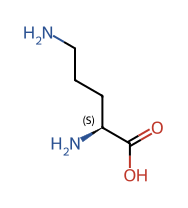
Ornithine is an amino acid with two amino groups that is not used to build proteins [1]. It is best known as the carrier molecule of the urea cycle, the pathway in the liver that turns waste ammonia into urea, and its discovery as part of that cycle in 1932 was the first description of a metabolic cycle [2]. The body makes ornithine for itself, mainly in the intestine from glutamine, glutamate and arginine [1].
Ornithine is also the starting point for the polyamines, small molecules that every dividing cell needs [3]. Combined with aspartate, it is used as a medicine for hepatic encephalopathy in people with cirrhosis, and it is sold as a supplement against fatigue, but the evidence for LOLA is of very low quality [4], and EFSA has not accepted a health claim for ornithine supplements [1].
| Formula | C5H12N2O2 [5] |
|---|---|
| Molar mass | 132.16 g/mol [5] |
| Made in the body from | Glutamine, glutamate and arginine [1] |
| Used in proteins | No [1] |
| Plasma level | 30–110 µmol/l [6] |
Discovery of ornithine
Ornithine was found in bird excrement. In 1877 the German chemist Max Jaffé, working in Königsberg, fed hens with benzoic acid. Mammals excrete benzoic acid combined with glycine as hippuric acid, but the hens excreted a different compound, for which Jaffé proposed the name ornithuric acid. When he boiled it with hydrochloric acid, it split into two molecules of benzoic acid and a new, strongly alkaline base with the formula C5H12N2O2. He suggested that the base was a diaminovaleric acid, which, as far as he knew, would make it the first diamino derivative of a fatty acid ever obtained [7]. Its formula and proposed structure correspond to ornithine, 2,5-diaminopentanoic acid [8].
Ornithine’s place in metabolism was found in 1932 by Hans Krebs and Kurt Henseleit, a medical student, in Freiburg. Using thin slices of liver, they found that urea was made very rapidly when both ornithine and ammonium salts were present. One molecule of ornithine could bring about the formation of more than 20 molecules of urea without being used up, so it acted like a catalyst. Krebs reasoned that ornithine must be converted into arginine, through citrulline, and that arginine must then be split back into ornithine and urea. It was the first metabolic pathway shown to run as a cycle [2].
Chemical structure of ornithine
Ornithine is 2,5-diaminopentanoic acid: an α-amino acid whose side chain of three carbon atoms ends in a second amino group [8]. It is one carbon shorter than lysine, which has a chain of four carbons. Ornithine has the same carbon skeleton as citrulline and arginine, which carry a ureido and a guanidino group at the end of the chain instead of an amino group. The α-carbon is a stereocentre, and the natural form is L-ornithine, with the S configuration [8] [1].
With two amino groups and one carboxyl group, ornithine is a basic amino acid. Its isoelectric point is 9.73 [5], so at the pH of blood it carries a net positive charge. There is no codon for ornithine, and it is not built into proteins [1] [9].
Chemical and physical properties of ornithine
| IUPAC name | (2S)-2,5-Diaminopentanoic acid |
|---|---|
| Formula | C5H12N2O2 [5] |
| Molar mass | 132.16 g/mol [5] |
| Monoisotopic mass | 132.0899 Da (calculation) |
| SMILES | NCCC[C@H](N)C(=O)O |
| InChI | InChI=1S/C5H12N2O2/c6-3-1-2-4(7)5(8)9/h4H,1-3,6-7H2,(H,8,9)/t4-/m0/s1 |
| InChIKey | AHLPHDHHMVZTML-BYPYZUCNSA-N |
| CAS Registry Number | 70-26-8 [8] |
| Melting point | 140 °C [5] |
| pKa values, 25 °C | 1.94; 8.78; 10.52 [5] |
| Isoelectric point | 9.73 [5] |
| Solubility | Very soluble in water and ethanol [8] |
Free L-ornithine forms microcrystals from alcohol–ether. It is usually handled as L-ornithine monohydrochloride (CAS 3184-13-2, molar mass 168.62 g/mol), which forms needles melting at 215 °C and is very soluble in water [8]; its MDL number is MFCD00064562. Supplements usually contain this salt [9].
Ornithine and the urea cycle
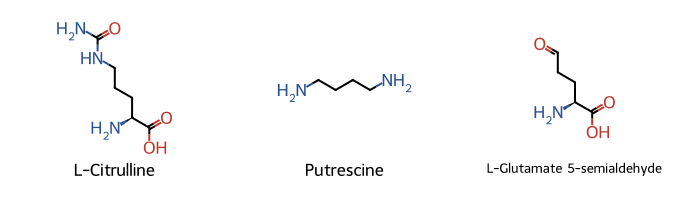
Breaking down protein releases ammonia, which is toxic to the brain. The urea cycle in the liver converts it into urea, which the kidneys excrete, and it disposes of about 80% of the body’s nitrogen waste [6]. Ornithine carries the cycle round. Inside the mitochondria, ornithine transcarbamylase joins it to carbamoyl phosphate to form citrulline; further steps turn citrulline into arginine; and in the cytosol arginase splits arginine into urea and ornithine [1] [6]. The regenerated ornithine has to return into the mitochondria, carried by a transporter called ORNT1, before the cycle can turn again [6].
Because ornithine is regenerated at every turn, the cycle needs only a small, stable amount of it. The body makes what it needs from glutamine, glutamate and arginine, mostly in the intestine [1].
Other pathways
Ornithine aminotransferase
Ornithine is broken down by ornithine aminotransferase, a mitochondrial enzyme that needs pyridoxal phosphate, the active form of vitamin B6. It transfers the terminal amino group of ornithine to 2-oxoglutarate, giving glutamate 5-semialdehyde and glutamate. Glutamate 5-semialdehyde is in equilibrium with Δ1-pyrroline-5-carboxylate, which links ornithine to the synthesis of proline and glutamate [10].
Polyamines
Ornithine decarboxylase removes the carboxyl group of ornithine to form putrescine, which is converted into the polyamines spermidine and spermine. Polyamines bind to DNA and RNA and are needed for cell growth and protein synthesis; mice lacking the ornithine decarboxylase gene die early in embryonic development [3]. The enzyme is tightly regulated, although the supply of decarboxylated S-adenosylmethionine, not ornithine decarboxylase, limits how fast spermidine is made [3].
α-Difluoromethylornithine (DFMO), an inhibitor of ornithine decarboxylase, depletes cells of putrescine and spermidine and stops them dividing. Its effect is cytostatic rather than toxic: the cells resume growth when polyamines are restored. In high doses in humans it can cause high-frequency hearing loss, but in general it has proved remarkably non-toxic in clinical and animal studies [3].
Inherited disorders
Gyrate atrophy of the choroid and retina
Gyrate atrophy is a rare autosomal recessive disease caused by a deficiency of ornithine aminotransferase. Ornithine cannot be broken down and accumulates in the blood. Vision declines early in life: the first symptoms are often night blindness and narrowing of the visual field as the retina and choroid degenerate from the periphery, and the disease eventually leads to complete blindness. The incidence is estimated at about 1 in 1,500,000 births, but about 1 in 50,000 in Finland [10].
Treatment aims to lower ornithine. A 2021 systematic review by Balfoort and colleagues found 33 published studies with 107 patients, almost all case reports; there were no randomised trials. A diet low in protein, and therefore in arginine, lowered plasma ornithine by 16 to 91%, vitamin B6 lowered it in patients with certain enzyme variants, and lysine supplements lowered it by 21 to 34%. Two studies of siblings suggested that starting the diet early slows the damage to the retina, but the lack of defined clinical outcomes meant that the review could not draw conclusions on clinical effectiveness. The authors reported no conflicts of interest [10].
HHH syndrome
In hyperornithinaemia–hyperammonaemia–homocitrullinuria (HHH) syndrome, the mitochondrial ornithine transporter ORNT1 does not work. Ornithine cannot enter the mitochondria, so the urea cycle stalls and ammonia rises, while ornithine accumulates in the blood, reaching 200 to 1915 µmol/l. The disease is autosomal recessive and caused by variants in the SLC25A15 gene. About 122 cases have been reported; it is commonest in people of French-Canadian descent. Treatment is a protein-restricted diet with citrulline and the ammonia-removing drug sodium phenylbutyrate. Some patients deteriorate neurologically even when ammonia is well controlled [6].
L-ornithine L-aspartate in liver disease
In cirrhosis the liver clears ammonia poorly, and ammonia from the gut reaches the brain, contributing to hepatic encephalopathy, a decline in brain function that ranges from subtle problems with attention and complex tasks to obvious difficulties with speech, balance and daily functioning. L-ornithine L-aspartate (LOLA) is a stable salt of ornithine and aspartic acid that can be given by mouth or intravenously. It is thought to lower ammonia by stimulating the remaining urea cycle activity in the liver and the formation of glutamine, particularly in muscle [4].
A 2018 Cochrane review by Goh and colleagues identified 36 randomised trials with at least 2,377 participants, but could obtain data from only 29 of them. Compared with placebo or no treatment, LOLA appeared to reduce mortality and hepatic encephalopathy when all trials were pooled, but the quality of the evidence was very low and no benefit was seen in the few trials at low risk of bias. The review found no clear difference in non-serious adverse events compared with placebo or no treatment. Compared with lactulose, a standard treatment, it showed no difference. Many of the trials were unpublished, and many of the published ones had received support from the pharmaceutical industry. The reviewers concluded that they were very uncertain about the findings and that new placebo-controlled trials were needed [4]. The review received no funding; one of the six authors declared links with several pharmaceutical companies [4].
Ornithine supplements
Ornithine supplements are marketed for fatigue, liver health and sports performance. In 2011 EFSA assessed the claim that ornithine “helps to normalize liver function”, interpreted as a contribution to the regulation of the urea cycle. The references submitted were narrative reviews on the management of urea cycle disorders, with no original data. Since ornithine is made in the body, and no evidence was provided that dietary ornithine contributes to the urea cycle, EFSA concluded that a cause-and-effect relationship had not been established [1].
The study most often cited for fatigue is a 2008 Japanese crossover trial by Sugino and colleagues. Seventeen healthy adults took 2 g of ornithine hydrochloride a day for a week and 6 g on the eighth day, then cycled for four hours. In the group as a whole, ornithine did not reduce the feeling of fatigue compared with placebo at any time point; in the nine women, fatigue increased less and pedalling speed fell less than with placebo. The study was funded by Kyowa Hakko Kogyo, which supplied the ornithine [9].
This section summarises research. It is not medical advice.
Food sources of ornithine
Ornithine occurs in food mainly as a free amino acid, since it is not part of proteins. According to Sugino and colleagues, it is present in the freshwater clam Corbicula japonica and in dried shiitake mushrooms but is not abundant in meat or fish [9]. Because the body makes ornithine for itself, there is no dietary requirement for it [1].
In short
- Ornithine is 2,5-diaminopentanoic acid, a basic amino acid that is not built into proteins; it was first obtained in 1877 from the excrement of hens fed benzoic acid.
- It carries the urea cycle round, a role discovered by Krebs and Henseleit in 1932 as the first metabolic cycle.
- It is also the precursor of the polyamines and is linked to proline and glutamate through ornithine aminotransferase.
- Defects in its breakdown or transport cause gyrate atrophy, a blinding eye disease, and HHH syndrome, a urea cycle disorder.
- Evidence for L-ornithine L-aspartate in hepatic encephalopathy is of very low quality, and EFSA did not accept a liver-function claim for ornithine supplements.
References
- EFSA Panel on Dietetic Products, Nutrition and Allergies (NDA). Scientific Opinion on the substantiation of a health claim related to L-ornithine and contribution to the regulation of the urea cycle (ID 4270) pursuant to Article 13(1) of Regulation (EC) No 1924/2006. EFSA Journal 9(6):2251 (2011). https://doi.org/10.2903/j.efsa.2011.2251
- Krebs HA. The discovery of the ornithine cycle of urea synthesis. Trends in Biochemical Sciences 7(2):76–78 (1982). https://doi.org/10.1016/0968-0004(82)90083-4
- Pegg AE. Functions of polyamines in mammals. Journal of Biological Chemistry 291(29):14904–14912 (2016). https://doi.org/10.1074/jbc.R116.731661
- Goh ET, Stokes CS, Sidhu SS, Vilstrup H, Gluud LL, Morgan MY. L-ornithine L-aspartate for prevention and treatment of hepatic encephalopathy in people with cirrhosis. Cochrane Database of Systematic Reviews 2018, Issue 5, CD012410. https://doi.org/10.1002/14651858.CD012410.pub2
- Haynes WM, Lide DR, Bruno TJ, editors. Properties of amino acids. In: CRC Handbook of Chemistry and Physics, 97th edition, pp. 7-1–7-2. Boca Raton: CRC Press (2016).
- Camacho J, Rioseco-Camacho N. Hyperornithinemia-hyperammonemia-homocitrullinuria syndrome. In: Adam MP, Bick S, Mirzaa GM, et al., editors. GeneReviews. Seattle: University of Washington; first posted 31 May 2012, revised 10 April 2025. https://www.ncbi.nlm.nih.gov/books/NBK97260/
- Jaffé M. Ueber das Verhalten der Benzoësäure im Organismus der Vögel. Berichte der Deutschen Chemischen Gesellschaft 10:1925–1930 (1877).
- Haynes WM, Lide DR, Bruno TJ, editors. Physical constants of organic compounds. In: CRC Handbook of Chemistry and Physics, 97th edition, p. 3-428 (L-ornithine and L-ornithine monohydrochloride). Boca Raton: CRC Press (2016).
- Sugino T, Shirai T, Kajimoto Y, Kajimoto O. L-Ornithine supplementation attenuates physical fatigue in healthy volunteers by modulating lipid and amino acid metabolism. Nutrition Research 28(11):738–743 (2008). https://doi.org/10.1016/j.nutres.2008.08.008
- Balfoort BM, Buijs MJN, ten Asbroek ALMA, Bergen AAB, Boon CJF, Ferreira EA, Houtkooper RH, Wagenmakers MAEM, Wanders RJA, Waterham HR, Timmer C, van Karnebeek CD, Brands MM. A review of treatment modalities in gyrate atrophy of the choroid and retina (GACR). Molecular Genetics and Metabolism 134(1–2):96–116 (2021). https://doi.org/10.1016/j.ymgme.2021.07.010
