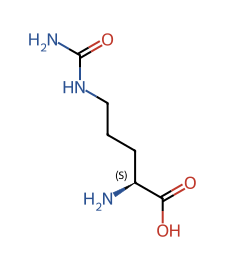
Citrulline is an α-amino acid closely related to arginine. It is not one of the 20 amino acids coded by the genetic code and is not built into proteins during their synthesis, yet it is found in every mammalian tissue [1]. The body makes citrulline in three places: in the liver as part of the urea cycle, in many tissues as a by-product of nitric oxide synthesis, and in the small intestine, which releases it into the blood for the kidneys to turn into arginine [1].
Citrulline is sold as a supplement, often as citrulline malate, on the grounds that it raises blood arginine more effectively than arginine itself. The European Food Safety Authority (EFSA) has twice concluded that a claim that citrulline malate speeds recovery from muscle fatigue was not substantiated [2] [3].
| Formula | C6H13N3O3 [4] |
|---|---|
| Molar mass | 175.19 g/mol [4] |
| Made in the body from | Glutamine and other amino acids (gut); arginine (nitric oxide synthesis) [1] |
| Used in protein synthesis | No; formed in proteins from arginine [1] |
| Plasma level in adults | About 20–50 µmol/l [1] |
Discovery and name
Citrulline takes its name from the watermelon, Citrullus vulgaris, which contains large amounts of it [1], and from which it was first isolated in the 1930s [5]. For decades it attracted little interest, because it is not a protein amino acid and was regarded only as an intermediate of the urea cycle [5]. In the early 1980s Windmueller and Spaeth showed that the small intestine releases large amounts of citrulline, which the liver does not take up and the kidney converts into arginine [5].
Chemical structure of citrulline
Citrulline is 2-amino-5-ureidopentanoic acid. Its side chain is a chain of three carbon atoms ending in a ureido group, –NH–CO–NH2. It is the same carbon skeleton as arginine and ornithine: ornithine ends in an amino group, citrulline in a ureido group, and arginine in a guanidino group [1]. The α-carbon is a stereocentre, and the natural form is L-citrulline, with the S configuration [1].
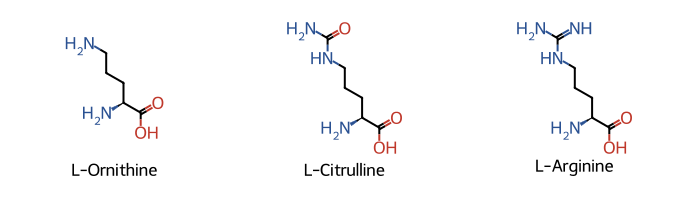
Unlike arginine, which has a net positive charge at physiological pH, citrulline has no net charge [1]. At physiological pH more than 99.9% of the neutral molecules are zwitterions, with a positively charged amino group and a negatively charged carboxyl group [1]. The reactivity of the ureido group underlies its biology: in the urea cycle aspartate attacks its carbon atom to form argininosuccinate. Industrially, citrulline is made from arginine by hydrolysing its guanidino group, which releases ammonia [1].
Chemical and physical properties of citrulline
| IUPAC name | (2S)-2-Amino-5-(carbamoylamino)pentanoic acid |
|---|---|
| Other name | N5-(Aminocarbonyl)-L-ornithine [6] |
| Formula | C6H13N3O3 [4] |
| Molar mass | 175.19 g/mol [4] |
| Monoisotopic mass | 175.0957 Da (calculation) |
| SMILES | NC(=O)NCCC[C@H](N)C(=O)O |
| InChI | InChI=1S/C6H13N3O3/c7-4(5(10)11)2-1-3-9-6(8)12/h4H,1-3,7H2,(H,10,11)(H3,8,9,12)/t4-/m0/s1 |
| InChIKey | RHGKLRLOHDJJDR-BYPYZUCNSA-N |
| CAS Registry Number | 372-75-8 [6] |
| MDL number | MFCD00064397 |
| Melting point | 222 °C [4] |
| pKa (COOH; NH3+), 25 °C | 2.32; 9.30 [4] |
| Isoelectric point | 5.92 [4] |
| Solubility | Soluble in water; insoluble in ethanol and methanol [6] |
Citrulline is a colourless solid that crystallises as prisms from aqueous methanol [6] [1]. Its polar side chain makes it very hydrophilic, with an octanol–water partition coefficient (log P) of −3.19 [1].
How the body makes and uses citrulline
Two enzymes make citrulline. Ornithine carbamoyltransferase (OCT) joins ornithine and carbamoyl phosphate; in humans it is found mainly in the liver and the lining of the small intestine. Nitric oxide synthase releases citrulline when it converts arginine into nitric oxide. Only one enzyme breaks citrulline down, argininosuccinate synthase, which joins it to aspartate on the way back to arginine [1]. These enzymes are spread differently across tissues, and the result is three largely separate pathways [1].
The urea cycle in the liver
In the liver, citrulline is an intermediate of the urea cycle, which turns waste ammonia into urea. It is made inside the mitochondria and converted to argininosuccinate in the cytosol as soon as it is formed, so the liver releases no citrulline into the blood. Liver cells also take up almost no citrulline from the blood [1].
From the gut to the kidney
Most of the citrulline in the blood comes from the cells lining the small intestine, which make it mainly from glutamine; glutamate, proline and, under some conditions, arginine can also serve as precursors. The kidney takes up about 83% of the citrulline released by the gut and converts it into arginine, which it releases into the blood. This route supplies about 60% of the arginine the body makes for itself, although only 5 to 15% of the arginine in the blood [1]. Because the liver does not take up citrulline, it acts as a disguised form of arginine that can pass the liver, which would otherwise remove most dietary arginine from the portal blood [1]. In adults this pathway meets the body’s needs and citrulline is not an essential amino acid, but in newborns it is not enough [1].
The nitric oxide cycle
Cells that make nitric oxide can convert citrulline back into arginine and use it again. In activated macrophages, a type of white blood cell, this recycling accounts for up to 20% of the nitric oxide produced [1].
Citrulline as a marker of gut function
Because the small intestine is the main source of citrulline in the blood, its level reflects how much working intestine a person has. In 2000 Crenn and colleagues in Paris measured fasting plasma citrulline in 57 adults with short-bowel syndrome, after surgical removal of much of the small intestine, and in 51 healthy volunteers. The patients had half the normal level, 20 versus 40 µmol/l on average, and the level was closely related to the length of the remaining small intestine. In these patients, assessed at least two years after their last intestinal surgery, a level below 20 µmol/l distinguished permanent intestinal failure, in which patients could not be weaned off intravenous feeding, from transient failure with a sensitivity of 92% and a specificity of 90%. Citrulline was not related to body mass index or to creatinine clearance, but kidney failure with a creatinine clearance below 50 ml/min raises plasma citrulline [7]. Plasma citrulline has since been used to monitor other conditions that damage the intestinal lining [1].
Inherited disorders
Several rare inherited disorders of the urea cycle affect citrulline. In ornithine carbamoyltransferase deficiency, which is X-linked, citrulline cannot be made and blood levels are low. In citrullinaemia, citrulline accumulates because it cannot be broken down; type I is caused by recessive mutations in the argininosuccinate synthase gene, and type II by mutations in the gene for citrin, a mitochondrial transporter. In all of them the urea cycle fails and ammonia builds up in the blood, which can lead to coma and death [1].
Citrulline itself is used as a treatment. In deficiencies of ornithine carbamoyltransferase or carbamoyl phosphate synthetase, in which the later steps of the cycle still work, it helps to remove ammonia. In lysinuric protein intolerance, in which the gut cannot absorb arginine, citrulline is absorbed by a different transporter and supplies the arginine the body lacks [1].
Citrulline in proteins
There is no codon for citrulline, so it is never built into proteins as they are made. Citrulline residues in proteins arise afterwards, when enzymes called peptidylarginine deiminases convert arginine residues into citrulline, releasing ammonium. The enzymes depend on calcium, and four types are found in humans [1]. Because arginine is positively charged and citrulline is neutral, the conversion changes how a protein interacts with others. It is part of the normal formation of skin and hair, where it modifies filaggrin, keratin and trichohyalin, and it also affects myelin basic protein in the nervous system and probably histones in cell nuclei [1].
Citrullinated proteins are central to the diagnosis of rheumatoid arthritis. In 1998 Schellekens and colleagues at the University of Nijmegen showed that antibodies long known to be specific for rheumatoid arthritis recognise citrulline. They made short peptides from filaggrin in which arginine was replaced by citrulline. Using several of these peptides, they found antibodies in 76% of 134 sera from patients with rheumatoid arthritis and in only 4% of sera from patients with other rheumatic and autoimmune diseases, a specificity of 96%. When citrulline was replaced by arginine or ornithine, the antibodies no longer bound. Because these antibodies can be present early in the disease, the authors suggested that citrullinated proteins may play a part in causing it [8].
Citrulline supplements
A better source of arginine than arginine
Arginine taken by mouth is largely broken down in the gut and liver before it reaches the circulation, whereas citrulline is not [9]. In a 2008 study in Hamburg, Schwedhelm and colleagues gave 20 healthy volunteers, average age 57, each of six treatments for a week. The volunteers had been selected for high blood levels of asymmetric dimethylarginine, a natural inhibitor of nitric oxide synthesis. Citrulline 0.75 g twice a day raised blood arginine as much as arginine 1.6 g twice a day in slow-release form or 1 g three times a day; 3 g of citrulline twice a day raised it more, and increased urinary nitrate and cyclic GMP, markers of nitric oxide production. None of the treatments improved the dilation of the brachial artery, a measure of blood-vessel function [9]. The study was sponsored by Angiogenix, a company whose chief medical officer was one of the authors [9].
In the Citrudose study, eight healthy young men took single doses of 2, 5, 10 and 15 g of citrulline. Blood citrulline rose 10- to 100-fold and returned to normal within 5 to 8 hours, and blood arginine and ornithine rose as well. Less than 5% of the dose was lost in the urine. At 15 g, arginine rose less than expected, suggesting that the kidney’s capacity to convert citrulline had been reached [5]. The study was funded by Laboratoires Biocodex, which makes a citrulline malate product [5] [2].
Exercise performance
Citrulline is popular as a pre-workout supplement. A 2021 meta-analysis by Vårvik and colleagues pooled eight double-blind, placebo-controlled trials with 137 mostly strength-trained participants. Taking 6 to 8 g of citrulline malate 40 to 60 minutes before exercise increased the number of repetitions to failure by about three, or 6.4%, a small effect. The effect was not significant for the upper body, and after statistical correction for possibly missing small negative studies it was no longer significant. The authors concluded that inconsistent results call for more research. They received no funding and declared no conflicts of interest [10].
In a 2016 Japanese trial, 22 trained men took 2.4 g of L-citrulline daily for seven days, followed by another dose one hour before a 4-km cycling time trial. They completed the trial 1.5% faster than with placebo, 569 versus 578 seconds. The trial was funded by Kyowa Hakko Bio, which supplied the citrulline, and three of the four authors were its employees [11].
What the European assessment found
Citrulline malate is a salt of L-citrulline and DL-malic acid in a 1:1 ratio. In 2012 EFSA assessed a claim by Biocodex that it speeds recovery from muscle fatigue after exercise, at 3 g a day for adults. Most of the human studies submitted were in patients with various forms of fatigue rather than muscle fatigue after exercise, and in the only study in athletes the statistical analysis did not take account of the crossover design. EFSA concluded that a cause-and-effect relationship had not been established [2]. In 2014 it assessed a second application from Biocodex for the same claim. Of the 35 references, all but two had been submitted before, and EFSA again found that the claim had not been substantiated [3].
Muscle in old age
Because citrulline passes the liver, a research group in Paris has proposed it as a way to deliver more nitrogen to muscle in older people. In old malnourished rats citrulline increased muscle protein synthesis and muscle mass, and in one study in 10 healthy adults on a low-protein diet, citrulline increased muscle protein synthesis compared with other amino acids. The authors stressed that human studies were needed; all three declared that they were shareholders of the Citrage company [12].
This section summarises research. It is not medical advice.
Safety
In the Citrudose study, none of the volunteers had nausea, diarrhoea or other side effects even after a single 15 g dose, and blood pressure, blood counts and biochemistry were unchanged. This contrasts with arginine and ornithine, which often cause diarrhoea at doses above 10 g [5]. In the Hamburg study a week of citrulline was well tolerated [9]. In one of the exercise trials, 6 of 41 men reported stomach discomfort after citrulline malate [10]. EFSA’s assessments of citrulline malate did not evaluate its safety [2]. These were small, short-term studies in healthy people. The authors of the Hamburg study noted that the effects and side effects in people with raised citrulline levels, such as those with kidney failure, still needed to be investigated [9].
Food sources of citrulline
Citrulline occurs at high levels in watermelon and some other plants of the gourd family [1], but the amount in watermelon varies greatly with the variety and ripeness [5]. Blood citrulline in humans appears to vary with age but not with diet [1].
In short
- Citrulline is an α-amino acid with a ureido side chain, named after the watermelon; it is not coded by the genetic code.
- The small intestine makes it, mainly from glutamine, and the kidney turns it into arginine; in the liver it serves mainly as an intermediate of the urea cycle.
- Plasma citrulline is a marker of how much functioning small intestine remains.
- Enzymes convert arginine residues in proteins into citrulline, and antibodies against citrullinated proteins are a hallmark of rheumatoid arthritis.
- Citrulline raises blood arginine more effectively than arginine itself; its effect on exercise is small and uncertain, and EFSA did not accept a recovery claim for citrulline malate.
References
- Curis E, Nicolis I, Moinard C, Osowska S, Zerrouk N, Bénazeth S, Cynober L. Almost all about citrulline in mammals. Amino Acids 29(3):177–205 (2005). https://doi.org/10.1007/s00726-005-0235-4
- EFSA Panel on Dietetic Products, Nutrition and Allergies (NDA). Scientific Opinion on the substantiation of a health claim related to citrulline-malate and faster recovery from muscle fatigue after exercise pursuant to Article 13(5) of Regulation (EC) No 1924/2006. EFSA Journal 10(5):2699 (2012). https://doi.org/10.2903/j.efsa.2012.2699
- EFSA Panel on Dietetic Products, Nutrition and Allergies (NDA). Scientific Opinion on the substantiation of a health claim related to citrulline-malate and faster recovery from muscle fatigue after exercise pursuant to Article 13(5) of Regulation (EC) No 1924/2006. EFSA Journal 12(5):3650 (2014). https://doi.org/10.2903/j.efsa.2014.3650
- Haynes WM, Lide DR, Bruno TJ, editors. Properties of amino acids. In: CRC Handbook of Chemistry and Physics, 97th edition, pp. 7-1–7-2. Boca Raton: CRC Press (2016).
- Moinard C, Nicolis I, Neveux N, Darquy S, Bénazeth S, Cynober L. Dose-ranging effects of citrulline administration on plasma amino acids and hormonal patterns in healthy subjects: the Citrudose pharmacokinetic study. British Journal of Nutrition 99(4):855–862 (2008). https://doi.org/10.1017/S0007114507841110
- Haynes WM, Lide DR, Bruno TJ, editors. Physical constants of organic compounds. In: CRC Handbook of Chemistry and Physics, 97th edition, p. 3-126 (citrulline). Boca Raton: CRC Press (2016).
- Crenn P, Coudray-Lucas C, Thuillier F, Cynober L, Messing B. Postabsorptive plasma citrulline concentration is a marker of absorptive enterocyte mass and intestinal failure in humans. Gastroenterology 119(6):1496–1505 (2000). https://doi.org/10.1053/gast.2000.20227
- Schellekens GA, de Jong BA, van den Hoogen FH, van de Putte LB, van Venrooij WJ. Citrulline is an essential constituent of antigenic determinants recognized by rheumatoid arthritis-specific autoantibodies. Journal of Clinical Investigation 101(1):273–281 (1998). https://doi.org/10.1172/JCI1316
- Schwedhelm E, Maas R, Freese R, Jung D, Lukacs Z, Jambrecina A, Spickler W, Schulze F, Böger RH. Pharmacokinetic and pharmacodynamic properties of oral L-citrulline and L-arginine: impact on nitric oxide metabolism. British Journal of Clinical Pharmacology 65(1):51–59 (2008). https://doi.org/10.1111/j.1365-2125.2007.02990.x
- Vårvik FT, Bjørnsen T, Gonzalez AM. Acute effect of citrulline malate on repetition performance during strength training: a systematic review and meta-analysis. International Journal of Sport Nutrition and Exercise Metabolism 31(4):350–358 (2021). https://doi.org/10.1123/ijsnem.2020-0295
- Suzuki T, Morita M, Kobayashi Y, Kamimura A. Oral L-citrulline supplementation enhances cycling time trial performance in healthy trained men: double-blind randomized placebo-controlled 2-way crossover study. Journal of the International Society of Sports Nutrition 13:6 (2016). https://doi.org/10.1186/s12970-016-0117-z
- Breuillard C, Cynober L, Moinard C. Citrulline and nitrogen homeostasis: an overview. Amino Acids 47(4):685–691 (2015). https://doi.org/10.1007/s00726-015-1932-2
