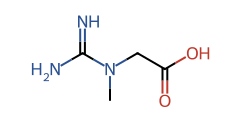
Creatine is a nitrogen-containing acid made in the body from three amino acids, arginine, glycine and methionine, and also taken in with meat and fish [1]. It is not built into proteins. About 95% of the body’s creatine is in skeletal muscle [1], where phosphocreatine serves as a rapidly available reserve for regenerating ATP during intense effort.
Creatine monohydrate is one of the most studied sports supplements. The European Food Safety Authority (EFSA) has concluded that it improves performance in short, repeated bouts of high-intensity exercise [1] and that, taken daily, it enhances the effect of resistance training on muscle strength in adults over 55 [2]. Claims that it improves cognitive function have not been established [3] [4].
| Formula | C4H9N3O2 [5] |
|---|---|
| Molar mass | 131.13 g/mol [5] |
| Made in the body from | Arginine, glycine and methionine [1] |
| Used in proteins | No |
| Body content (70 kg man) | About 120 g [6] |
| Turned into creatinine | About 2 g a day [6] |
Discovery of creatine
Creatine was discovered by the French chemist Michel Eugène Chevreul, who described it in a study of the chemical composition of meat broth published in 1835. Its name comes from the Greek kreas, flesh [6].
Interest in creatine as a supplement began in 1992, when Roger Harris, Karin Söderlund and Eric Hultman in Stockholm reported that taking it by mouth raises the amount of creatine in human muscle. The study involved 17 volunteers aged 20 to 62. In those who took 5 g of creatine monohydrate four to six times a day for two days or more, the total creatine content of the thigh muscle rose on average from 126.8 to 148.6 mmol per kg of dry muscle, by as much as 50% in some subjects. The rise was greatest in those who started with the lowest content, and about 155 mmol/kg appeared to be an upper limit. One hour of hard exercise a day with one leg raised the content further in the exercised leg. No side effects were noted [7].
Chemical structure of creatine
Creatine is N-amidino-N-methylglycine. Its backbone is sarcosine, which is glycine with a methyl group on the nitrogen, and the same nitrogen carries an amidino group, –C(=NH)NH2, forming a guanidino group like the one in the side chain of arginine. The molecule has no stereocentre, so it has no L and D forms. In water at physiological pH the carboxyl group is ionised and the guanidino group protonated, so creatine exists as a zwitterion [5].
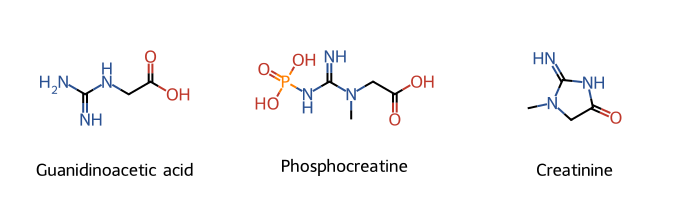
Two closely related molecules are central to its biology. Guanidinoacetic acid is creatine without the methyl group and is its direct precursor. Phosphocreatine carries a phosphoryl group on the guanidino nitrogen. Creatinine is the cyclic breakdown product, formed when the carboxyl group condenses with the guanidino group and water is lost [6].
Chemical and physical properties of creatine
| IUPAC name | 2-[Carbamimidoyl(methyl)amino]acetic acid |
|---|---|
| Formula | C4H9N3O2 [5] |
| Molar mass | 131.13 g/mol [5] |
| Monoisotopic mass | 131.0695 Da (calculation) |
| SMILES | CN(CC(=O)O)C(=N)N |
| InChI | InChI=1S/C4H9N3O2/c1-7(4(5)6)2-3(8)9/h2H2,1H3,(H3,5,6)(H,8,9) |
| InChIKey | CVSVTCORWBXHQV-UHFFFAOYSA-N |
| CAS Registry Number | 57-00-1 [8] |
| MDL number | MFCD00004282 |
| Melting point | 303 °C, with decomposition [5] |
| pKa (COOH; guanidinium), 25 °C | 2.63; 14.30 [5] |
| Density | 1.33 g/cm3 [8] |
| Solubility in water, 25 °C | 16 g per kg of water [5] |
Creatine crystallises from water as monoclinic prisms of the monohydrate, the form usually sold as a supplement. It is soluble in water, slightly soluble in ethanol and insoluble in ether [8]. Its solubility is much lower than that of most amino acids: about 16 g per kg of water [5], compared with 105 g for taurine [5].
How the body makes creatine
Creatine is made in two steps. First, the enzyme L-arginine:glycine amidinotransferase (AGAT) transfers the amidino group of arginine to glycine, giving guanidinoacetic acid and ornithine. Then guanidinoacetate methyltransferase (GAMT) adds a methyl group, taken from S-adenosylmethionine, to give creatine [6].
The two enzymes are unevenly spread across organs. In mammals the kidney has fairly high AGAT activity but little GAMT, while the liver has high GAMT, and the pancreas has both. The classical view is that guanidinoacetate is made mainly in the kidney and methylated in the liver, and that creatine then travels in the blood to the tissues that need it. Measurements in humans suggest, however, that the liver may make most of both guanidinoacetate and creatine, with the kidney playing a secondary role. Muscle makes almost no creatine itself and takes it up from the blood through a sodium- and chloride-dependent creatine transporter [6].
The first step is rate-limiting. When creatine is plentiful, from the diet or from supplements, AGAT is repressed, which probably helps the body to save arginine and methionine [6].
Phosphocreatine and energy
The enzyme creatine kinase transfers a phosphate group between ATP and creatine, in either direction [6]. Phosphocreatine is a readily available energy reserve in muscle. For most activities ATP comes mainly from oxidative metabolism in the mitochondria, but when aerobic energy production cannot keep up, as in short, very intense efforts, phosphocreatine rapidly converts ADP back to ATP. Its share of ATP production falls once such an effort lasts more than a few seconds [1]. In the 1992 study, about 20% or more of the extra creatine taken up by muscle was present as phosphocreatine, while the ATP content did not change [7].
Creatinine
Creatine and phosphocreatine slowly cyclise without any enzyme to form creatinine, at about 1.1% of creatine and 2.6% of phosphocreatine a day, or about 1.7% of the total pool. In a 70 kg man with about 120 g of creatine, roughly 2 g a day is lost this way and has to be replaced from the diet or by synthesis [6]. Creatinine passes freely out of cells into the blood and is excreted by the kidneys. Because it is formed at a nearly constant rate and more than 90% of the body’s creatine is in muscle, daily urinary creatinine is used as a rough measure of muscle mass [6], and blood creatinine is a standard marker of kidney function [9].
Creatine deficiency disorders
Three rare inherited disorders deprive the brain of creatine. Two block its synthesis: GAMT deficiency, reported in about 130 people, and AGAT deficiency, reported in 16. Both are autosomal recessive. The third, creatine transporter deficiency, is caused by variants in the SLC6A8 gene on the X chromosome and has been reported in about 130 males. All three cause developmental delay, intellectual disability and speech problems; epilepsy and behaviour disorders are common in GAMT and transporter deficiency, and muscle weakness occurs in about half of people with AGAT deficiency [10]. Brain scans with proton magnetic resonance spectroscopy show little or no creatine [10].
The two synthesis disorders are treated with high doses of creatine monohydrate, 400 to 800 mg per kg of body weight a day. In GAMT deficiency, ornithine and a diet low in arginine or protein are added to reduce guanidinoacetate, which accumulates to toxic levels. Some children diagnosed and treated from the newborn period have developed normally. Transporter deficiency is treated with creatine together with arginine and glycine, although the benefit of this treatment has not been confirmed [10].
Creatine supplements
Raising muscle creatine
Taking creatine raises the total creatine content of muscle by about 15–20% on average, with large differences between individuals. This can be achieved with 20 g a day for 4 to 5 days, the so-called loading phase, or with 3 g a day for a month; about 2 g a day maintains the raised level. Short-term loading typically adds 1 to 3 kg of body weight within a week, thought to be mostly water retained with the creatine [1].
Exercise performance
In 2011 EFSA concluded that creatine increases physical performance during short-term, high-intensity, repeated exercise bouts, with 3 g a day, in adults performing high-intensity exercise. The main evidence was a meta-analysis of 100 placebo-controlled trials with 1,847 participants, which found a small effect on efforts lasting 30 seconds or less and none on efforts longer than 150 seconds. In very high-power efforts separated by short rests, performance in the later bouts can be 5 to 20% higher. EFSA found that an effect on endurance capacity and endurance performance had not been established [1].
Muscle strength in older adults
In 2016 EFSA assessed a claim submitted by the German chemical company AlzChem that creatine enhances the effect of resistance training on muscle strength in adults over 55. In five of six studies in which participants took 3 to 6 g of creatine every day and trained three times a week, creatine increased strength more than training alone. Four studies in which creatine was taken only on training days showed no effect. EFSA concluded that daily creatine can enhance the effect of resistance training on muscle strength in this age group, with 3 g a day and training at least three times a week for several weeks at 65–75% of the maximum load that can be lifted once [2].
Cognitive function
Health claims that creatine improves cognitive function have not been established. In 2024 EFSA assessed an application from Alzchem. The applicant identified 21 human studies and EFSA found two more. Two of them found better working memory, both with 20 g a day for 5 to 7 days; studies with 2.2 to 14 g a day did not. Three studies in people with diseases did not support an effect, and the evidence for a mechanism was weak. EFSA concluded that a cause-and-effect relationship had not been established [3]. The same year the UK Nutrition and Health Claims Committee assessed a similar claim, also from Alzchem, for 3 g a day or less. Only one of the ten trials submitted tested such a dose in a suitable population: 22 healthy participants took 2.2 g a day for six weeks, with no effect on cognition. The committee found that a cause-and-effect relationship had not been established [4].
Muscle diseases
A Cochrane review of 14 randomised trials with 364 participants found that in muscular dystrophies creatine increased muscle strength by about 8.5% compared with placebo (six trials, 192 participants). In four trials with 115 participants, more people felt better while taking creatine than while taking placebo. In metabolic muscle diseases it did not increase strength, and in McArdle disease high doses made daily activities harder and increased muscle pain [11]. All three authors had taken part in trials of creatine in muscle diseases, and one had sat on the scientific advisory board of a sports nutrition company; he stated that the trials he coordinated were not funded by industry [11].
This section summarises research. It is not medical advice.
Safety and the kidneys
Because creatine is turned into creatinine, taking it can raise blood creatinine, the usual marker of kidney function, and this has caused concern about kidney damage. A 2025 meta-analysis by Kabiri Naeini and colleagues at Isfahan University of Medical Sciences included 21 studies of people of any age and health status. In 12 studies with 440 participants, creatine raised serum creatinine slightly; in 5 studies with 143 participants, it did not significantly change the glomerular filtration rate, a more direct measure of kidney function. The authors concluded that the rise in creatinine is more likely due to creatine turnover than to kidney damage [9]. The studies varied widely and were small, many did not report how creatinine was measured, and some laboratory methods are affected by creatine itself [9]. The study received no funding, and the authors declared no competing interests [9].
For children with creatine deficiency disorders, who take far higher doses for years, the GeneReviews authors recommend checking kidney function every year [10].
Food sources of creatine
Creatine is found in meat and fish. A normal mixed diet supplies up to about 1 g a day, and the body makes the rest of the roughly 2 g a day that it needs [7]. A single 5 g supplement dose contains as much creatine as about 1.1 kg of fresh, uncooked steak [7]. In the 1992 study two vegetarians, who eat almost no creatine, still had muscle creatine within the normal range [7].
In short
- Creatine is N-amidino-N-methylglycine, a nitrogen-containing acid that is not used in proteins; it was found in meat broth in the 1830s.
- The body makes it from arginine, glycine and methionine and keeps about 95% of it in skeletal muscle, mostly as a reserve for regenerating ATP.
- About 2 g a day turns into creatinine, which the kidneys excrete.
- Rare inherited creatine deficiency disorders affect the brain; the synthesis defects are treated with high doses of creatine.
- EFSA has accepted that creatine improves short, repeated high-intensity exercise and, with daily intake, the strength gained from resistance training after 55; claims for endurance and cognition were not established.
- Creatine raises blood creatinine slightly, but a meta-analysis found no significant change in kidney filtration.
References
- EFSA Panel on Dietetic Products, Nutrition and Allergies (NDA). Scientific Opinion on the substantiation of health claims related to creatine and increase in physical performance during short-term, high intensity, repeated exercise bouts (ID 739, 1520, 1521, 1522, 1523, 1525, 1526, 1531, 1532, 1533, 1534, 1922, 1923, 1924), increase in endurance capacity (ID 1527, 1535), and increase in endurance performance (ID 1521, 1963) pursuant to Article 13(1) of Regulation (EC) No 1924/2006. EFSA Journal 9(7):2303 (2011). https://doi.org/10.2903/j.efsa.2011.2303
- EFSA Panel on Dietetic Products, Nutrition and Allergies (NDA). Creatine in combination with resistance training and improvement in muscle strength: evaluation of a health claim pursuant to Article 13(5) of Regulation (EC) No 1924/2006. EFSA Journal 14(2):4400 (2016). https://doi.org/10.2903/j.efsa.2016.4400
- EFSA Panel on Nutrition, Novel Foods and Food Allergens (NDA). Creatine and improvement in cognitive function: evaluation of a health claim pursuant to Article 13(5) of Regulation (EC) No 1924/2006. EFSA Journal 22:e9100 (2024). https://doi.org/10.2903/j.efsa.2024.9100
- UK Nutrition and Health Claims Committee (UKNHCC). UKNHCC scientific opinion: creatine supplementation and improved cognitive function. Office for Health Improvement and Disparities, published 14 August 2024. https://www.gov.uk/government/publications/uknhcc-scientific-opinion-creatine-supplementation-and-improved-cognitive-function
- Haynes WM, Lide DR, Bruno TJ, editors. Properties of amino acids. In: CRC Handbook of Chemistry and Physics, 97th edition, pp. 7-1–7-2. Boca Raton: CRC Press (2016).
- Wyss M, Kaddurah-Daouk R. Creatine and creatinine metabolism. Physiological Reviews 80(3):1107–1213 (2000). https://doi.org/10.1152/physrev.2000.80.3.1107
- Harris RC, Söderlund K, Hultman E. Elevation of creatine in resting and exercised muscle of normal subjects by creatine supplementation. Clinical Science 83(3):367–374 (1992). https://doi.org/10.1042/cs0830367
- Haynes WM, Lide DR, Bruno TJ, editors. Physical constants of organic compounds. In: CRC Handbook of Chemistry and Physics, 97th edition, p. 3-128 (creatine). Boca Raton: CRC Press (2016).
- Kabiri Naeini E, Eskandari M, Mortazavi M, Gholaminejad A, Karevan N. Effect of creatine supplementation on kidney function: a systematic review and meta-analysis. BMC Nephrology 26:622 (2025). https://doi.org/10.1186/s12882-025-04558-6
- Mercimek-Andrews S, Salomons GS. Creatine deficiency disorders. In: Adam MP, Bick S, Mirzaa GM, et al., editors. GeneReviews. Seattle: University of Washington; first posted 15 January 2009, revised 7 August 2025. https://www.ncbi.nlm.nih.gov/books/NBK3794/
- Kley RA, Tarnopolsky MA, Vorgerd M. Creatine for treating muscle disorders. Cochrane Database of Systematic Reviews 2013, Issue 6, CD004760. https://doi.org/10.1002/14651858.CD004760.pub4
